1915: The Great Retreat of the Russian army
Defence of Osowiec
- Dates:
- 16 February – 22 August 1915
- Front:
- Eastern Front
- Location:
- Osowiec Fortress on the Biebrza, on the railway from Lyck via Grajewo to Białystok, on the border of Congress Poland and Grodno Governorate, Russian Empire (today Osowiec-Twierdza in Gmina Goniądz, Podlaskie Voivodeship, Poland)On the battle map →
- Sides:
- Russian EmpireNikolai BrzhozovskyGerman EmpirePaul von Hindenburg, Friedrich von Scholtz, Rudolf von Freudenberg
- Result:
- Russian defensive victory, but the fortress was eventually given up. The Germans took it neither by bombardment nor by gas attack. In August 1915 the Russians withdrew the garrison on orders from the high command and blew up the fortifications.
- Author:
- Natalia
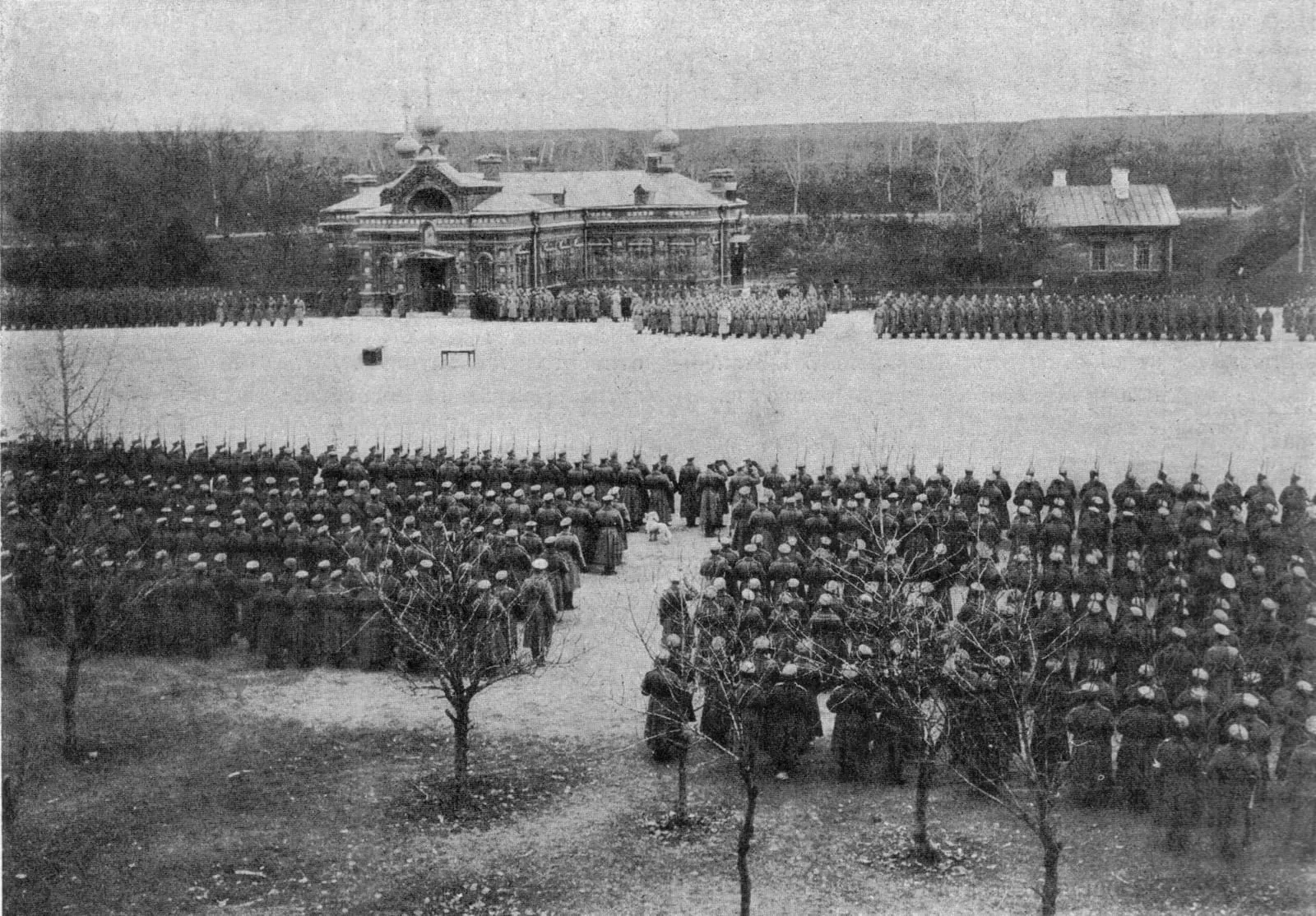
Osowiec Fortress was a small Russian barrier fortress on the Biebrza, at the point where the railway from East Prussia to Białystok crossed the vast marshes. In 1915 it held out for more than half a year. In February and March it withstood bombardment by the heaviest German siege guns, and on 6 August it repulsed an assault preceded by a gas attack, which passed into legend as the “Attack of the Dead Men”. It was never taken. In the second half of August, when after the fall of Warsaw, Kovno and Novogeorgievsk the whole Russian front was falling back eastwards, the garrison withdrew on orders from the high command and sappers blew up the fortifications. Today the ruins of the fortress lie in Poland, in the settlement of Osowiec-Twierdza, on the edge of Biebrza National Park.
Name and dates
The Russians called the fortress Osovets (Osowiec), the Germans Ossowiec or Ossowitz. Russian literature speaks of three German assaults: in September 1914, in February and March 1915, and in July and August 1915. The first was a brief episode, described below under the background. This page describes the defence of 1915, which one of its participants and its historian, Sergei Khmelkov, treated as a single siege: from February the fortress was continuously attacked or blockaded until its evacuation in August.
We take the dates as 16 February – 22 August 1915. On 16 February Russian troops, pushed back from Grajewo, occupied the fortress’s advanced positions and the fighting for its approaches began. In Russian sources using the Julian calendar the same day is 3 February. On 22 August, according to most accounts, the garrison completed its march out of the fortress. Russian and Polish sources differ, however, on the details of the end. According to Khmelkov the last sappers blew up the fortifications on the evening of 23 August, and the Germans entered the ruins on 25 August. A German war communiqué of 23 August had already announced the occupation of the fortress abandoned by the Russians. Dates in this text are given according to the Gregorian calendar.
Background
Osowiec was built in the 1880s as a barrier on the road from East Prussia into the interior of Russia. The fortress lay a dozen or so kilometres from Grajewo, near which ran the border with Germany, at the only place where a road and a railway crossed the Biebrza Marshes. There was no way round it: marshland stretched to the north and south. It consisted of four forts, one of which, Zarzeczny, stood on the other side of the river, and in front of them lay a belt of advanced field positions. Before the war it was regarded as a weak, “toy” fortress, unprepared for the fire of modern siege artillery. It was armed mainly with old 152 mm guns of the 1877 pattern and 107 mm guns.
The Germans first approached Osowiec in September 1914, when the 8th Army was pursuing the Russians after the Battle of the Masurian Lakes. The shelling of the fortress with guns of up to 210 mm calibre, conducted from 26 September, had no effect, and an assault failed. A few days later, under pressure from the Russian 10th Army attacking on the Niemen, the Germans withdrew from the fortress. The commandant of the fortress at that time was General Karl Schulmann, and the fire of the fortress artillery was directed by its commander, Major-General Nikolai Brzhozovsky, a veteran of the war with Turkey and of the defence of Port Arthur. At the end of January 1915 Brzhozovsky became commandant of the whole fortress.
In February 1915 the Germans launched an offensive in East Prussia that went down in history as the Second Battle of the Masurian Lakes. The left wing of the Russian 10th Army was covered by the 57th Infantry Division, which after the fighting of 7–8 February began to fall back towards Osowiec. Its regiments became part of the garrison. The fortress found itself at the junction of the 10th and 12th Armies, and the Germans wanted to break through it to Białystok, an important railway junction in the rear of both armies.
Course
Fighting for the approaches (16–22 February)
From 11 to 15 February a Russian covering detachment held out at Grajewo to allow time for the evacuation of the railway station and to cover the retreating troops. On the evening of 15 February it fell back to the fortress’s advanced positions near the villages of Ciemnoszyje and Białaszewo. From 17 February the Germans attacked them along the whole front, and the fortress artillery joined the fighting. Further infantry regiments were sent to help the defenders. On 21 February, after heavy shelling, the Russian left wing gave way. Brzhozovsky decided that there was no sense in bleeding the exhausted soldiers further on the approaches, and on the night of 21–22 February he withdrew them to the position at Sośnia and into the fortress. The retreat along a narrow causeway across the marshes was carried out without losses.
The fortress was besieged by the German 11th Landwehr Division of General Rudolf von Freudenberg with attached units, according to Khmelkov about 40 battalions in all. The garrison numbered about 27 battalions, including several battalions of poorly trained militia (opolchenie).
Bombardment (25 February – 3 March)
The Germans brought up 17 batteries of siege artillery (PL) against the fortress, according to Khmelkov 68 heavy guns. Among them were Austro-Hungarian Škoda 305 mm mortars and one battery of the heaviest German 420 mm mortars, known as Big Bertha. These guns were placed in the woods, 8–12 kilometres from the forts, beyond the range of the old Russian guns. The shelling began on 25 February, intensified on 27 and 28 February, and gradually weakened after 3 March. Some accounts date the heaviest bombardment to the period from mid-February to 5 March. According to figures cited by Khmelkov the Germans fired about 200,000 heavy shells, but only about 30,000 craters were counted on the fortress grounds. The rest were presumably swallowed by the marshes, the river and the moats. The fortress was also bombed by aircraft.
From a distance it seemed that no one in Osowiec could survive. Newspaper correspondents compared the fortress to hell and to an active volcano, and the 12th Army command asked the garrison to hold out for another 48 hours. The material damage, however, was smaller than it appeared. The wooden buildings burned down, the telephone communications and part of the ramparts were destroyed, but the concrete shelters and barracks held. The 420 mm shells hit the main fort only a few times. According to Khmelkov, Russian long-range guns damaged two German 420 mm mortars, badly camouflaged near the railway line, on the very same day. Some modern historians regard this account as inaccurate and maintain that the heavy mortars were simply sent to another sector of the front. The Russian infantry held the position at Sośnia and harassed the enemy with night sorties. When the bombardment ended, the Germans went over to positional warfare.
Spring and summer
For the following months the front at Osowiec stood still. The garrison expanded the advanced positions: the wire entanglements in front of the trenches at Białogrądy and Sośnia were in places 15 metres wide. The fortress had an open rear. Trains and lorries with ammunition, food and building materials arrived almost every night, even during the bombardment. In July, when the Central Powers began their great offensive against Congress Poland, the German trenches came within 150–200 metres of the wire of the Sośnia position. The defenders saw the enemy carrying out some kind of earthworks in front of his trenches, but did not guess their purpose. German pioneers were preparing a gas attack.
Gas attack (6 August)
The Germans set up 30 batteries of gas cylinders in front of the Sośnia position and for more than ten days waited for a wind blowing towards the fortress. On 6 August at about 4 a.m. they opened the cylinders and at the same time began an artillery bombardment. A dark green cloud of chlorine, according to Khmelkov mixed with bromine, rolled over a front of several kilometres onto the Russian trenches and then over the whole fortress. According to Khmelkov, after travelling 10 kilometres it was 8 kilometres wide and 10–15 metres high. Eighteen inhabitants of villages lying 12 kilometres from the point of release were severely poisoned. In the fortress the leaves turned yellow and the grass black, and copper objects were covered with a green coating. The garrison had no effective gas masks, and the recommended countermeasures, straw fires in front of the trenches and soaking the parapets with a lime solution, were of little use.
That morning the Sośnia position was defended by five companies of the 226th Zemlyansky Infantry Regiment and four militia companies. Three companies of the Zemlyansky Regiment, according to Khmelkov, perished almost to a man, and of the fourth about 40 men remained with one machine gun. Behind the gas the regiments of the 11th Landwehr Division moved to the attack. The 18th Landwehr Regiment cut through the wire, took the first and second lines of trenches and advanced along the railway track towards the only bridge over the canal, whose capture would have cut off part of the Russian positions. On the flanks the Germans became stuck. The 76th Landwehr Regiment, attacking from the south, walked into its own gas and suffered heavy losses.
Brzhozovsky ordered the artillery to open fire on the lost trenches and to throw everything at hand into a counter-attack. The gunners of the forts, despite losses among their poisoned crews, managed to cut the attacking Germans off from their reserves. From the Zarzeczny position the 8th, 13th and 14th Companies of the Zemlyansky Regiment set off to counter-attack; according to Khmelkov they had already lost half their men to the gas. The 13th Company of Second Lieutenant Vladimir Kotlinsky made a bayonet charge along the track. The surprised Germans fell back, and according to Khmelkov many of them were killed on the wire by the fire of the fortress artillery. Kotlinsky was mortally wounded and died the same day. Command passed to Second Lieutenant of Sappers Władysław Strzemiński, later one of the most outstanding Polish avant-garde painters. By about 11 a.m. the position was back in Russian hands. The Germans did not renew the assault.
Khmelkov, who was at Osowiec, later called this charge an attack of “dead men”, citing the words of an eyewitness. Today the “Attack of the Dead Men” is one of the best-known episodes of the Russian front in this war, but much of the popular description comes from journalism of recent decades. Russian historians who examined the military documents after 2010 confirmed that the counter-attack took place and ended in success. They pointed out, however, that more units took part in it than just a handful of survivors from one company, and that the most gruesome details, such as soldiers coughing up pieces of their lungs, were added by journalists a hundred years after the events. Khmelkov also noted that the reasons given for the German failure included losses from their own gas, panic in the 18th Landwehr Regiment and the reluctance of the Landwehr soldiers to attack across the marshes.
Evacuation and demolition of the fortress (18–23 August)
The repulse of the assault changed little in the fortress’s situation. Osowiec became the right wing of a front that was retreating eastwards. On 5 August the Germans took Warsaw, and in mid-month they broke through the Russian lines on the Narew and captured Kovno. Further defence of the isolated fortress threatened the loss of the garrison, the heavy artillery and the stores. The commandant received an order to evacuate, which according to Khmelkov began on 18 August. Several trains with guns managed to leave for Białystok, but on 20 August rail traffic stopped. The heavy guns had to be hauled at night along the road to Grodno on ropes, with 30–50 gunners or militiamen to each. By day the road was watched by German aircraft. On 22 August units of the German 8th Army crossed the Biebrza near Strękowa Góra and cut the railway from Osowiec to Białystok south of Knyszyn station. The garrison troops assembled at Suchowola, where they were formed into a separate corps under Brzhozovsky’s command.
Only the sappers, the fortress engineers and the crews of four guns, which fired all day to conceal the garrison’s departure, remained in the fortress. All the forts, batteries, shelters and barracks were prepared for demolition with charges of up to one and a half tonnes of pyroxylin. According to Khmelkov, on the evening of 23 August the sappers set fire to the buildings and from 8 p.m. began blowing up the fortifications, after which they left for Suchowola. The Germans occupied the abandoned ruins. A German communiqué of 23 August reported that German troops on the Biebrza had occupied “the fortress of Osowiec, abandoned by the Russians”. According to Khmelkov, German units entered the fortress only on 25 August.
Losses
Complete figures for the losses do not exist. The best documented is the attack of 6 August. According to Russian documents cited in more recent studies, the garrison lost about 700 killed and more than 3,000 wounded and gassed that day, and several hundred soldiers went missing. These figures also include units that took no part in the counter-attack but suffered from the gas and artillery fire. German losses are much less well known. Russian accounts speak of heavy losses from their own gas and the fire of the forts, while surviving fragments of German documents indicate much smaller losses. Even less is known about the losses of February and March.
Significance
Osowiec was one of the few fortresses that in the first years of the war withstood the fire of heavy siege artillery. Its defenders survived in conditions in which Belgian and French fortresses had quickly fallen in 1914. Khmelkov attributed this above all to the fortress’s open rear, through which reinforcements and supplies flowed in, to the stubborn defence of the advanced positions, which kept the German guns away from the forts, and to the conduct of the commandant. He contrasted Osowiec with Novogeorgievsk, which in the same month capitulated after a siege of a couple of weeks, handing the Germans tens of thousands of prisoners.
Half a year of defence pinned down a whole German division with heavy artillery at Osowiec and closed to the Germans the shortest route from East Prussia to Białystok. The fortress did not, however, change the course of the Great Retreat. When, after the fall of Warsaw, Kovno and Novogeorgievsk, the Russian armies withdrew from Congress Poland, its further defence lost its point. The gas attack of 6 August was one of several large German gas attacks on the Eastern Front in the summer of 1915, and the counter-attack of the Zemlyansky Regiment became in Russia a symbol of soldierly endurance. In Poland the memory of the defence is also bound up with the figure of Strzemiński, who was decorated for the fighting at Osowiec and in May 1916, by then in Belarus, was severely wounded and lost an arm and a leg.
Spotted a mistake?Report an error