Key event
Third Battle of the Aisne begins
- Category:
- Military operations
- Front:
- Western Front
- Date:
- 27 May 1918
- Author:
- Łukasz Skowroń
- Battle:
- Third Battle of the Aisne
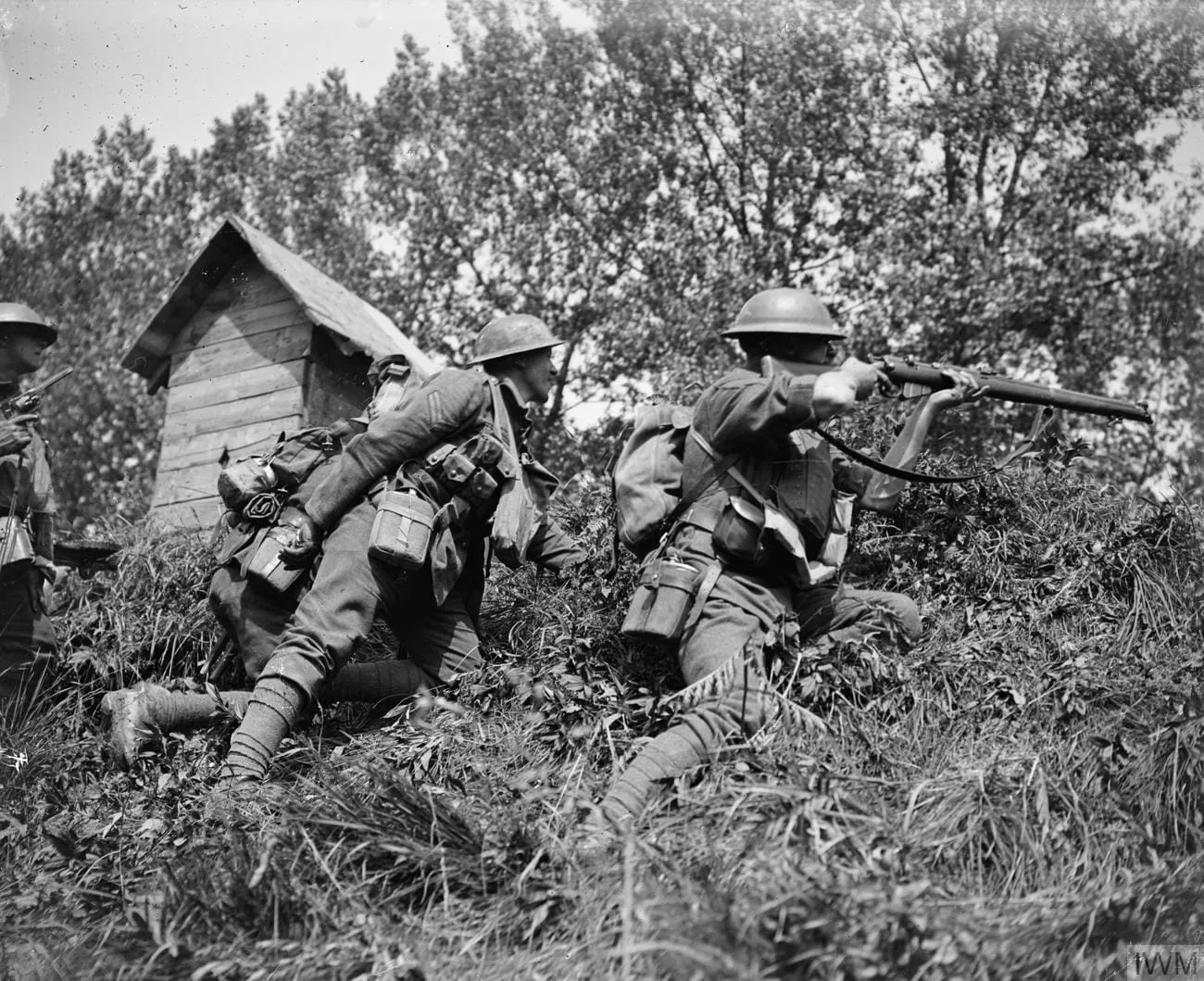
On Monday 27 May 1918, at one o’clock in the morning, in total darkness, for there was no moon, the German artillery opened fire on the front along the river Aisne, between Reims and Soissons. So began the third great offensive of spring 1918, which Erich Ludendorff had conceived as a diversionary blow to draw the French reserves away from Flanders. After two hours and forty minutes of the heaviest bombardment of the war, the German infantry advanced on the Chemin des Dames ridge, held by the French of General Denis Duchêne’s Sixth Army and four exhausted divisions of the British IX Corps, sent here to rest after the battles of March and April. Within a few hours the Germans took the whole ridge, for which the French had fought throughout 1917, crossed the Aisne by undamaged bridges, and by evening stood on the Vesle, about 20 kilometres from their starting trenches. It was one of the greatest successes of the German army in the whole war in the west. Times are given as in the British official history, in Allied time, one hour behind German time.
The last evening
The Aisne sector was considered the quietest on the front. That is precisely why at the beginning of May General Ferdinand Foch and Douglas Haig sent here the British 8th, 21st, 25th and 50th Divisions under General Alexander Hamilton-Gordon, who in April had commanded IX Corps in the Battles of the Lys. Their battalions had been filled up largely with young, half-trained recruits. The soldiers welcomed with relief the beautiful green countryside, the comfortable trenches and the rare shelling. For several days, however, they had heard at night the tramp of marching columns, the rumble of wagons and the whispers of German working parties, and on 22, 23 and 24 May airmen saw clouds of dust on the roads behind the front. Hamilton-Gordon passed these reports on to the French, and the commander of the Northern Army Group, General Louis Franchet d’Espérey, assured him that an attack “will certainly not come at once”.
At about noon on 26 May the French XI Corps took two Germans prisoner, who stated that the great attack would begin at two in the morning German time, the next day or the day after, after two and a half hours of bombardment. Duchêne ordered the alert only between 4.20 and 4.30 p.m. There was time only to thin out the front line into a chain of outposts and bring up part of the reserves. The British 25th Division, in army reserve, was ordered to take up positions behind the Aisne, and the French reserve divisions moved towards the second line. There was no longer time to move the batteries, a large part of which stood north of the river. From 9 p.m. the Allied artillery kept up harassing fire on the roads behind the German front. No one knew that about 20 divisions and more than a thousand batteries were waiting in the woods opposite.
The bombardment
The fire, planned by Lieutenant-Colonel Georg Bruchmüller, covered a front about 38 kilometres long, from Berry-au-Bac to Chavignon, and to deceive the enemy the neighbouring German corps shelled even wider sectors, from Brimont near Reims to the outskirts of Soissons. The British official history calculates that 855 batteries fired on the 24 miles of the attack front, and as many as 466 on the sector of the British 50th Division and the French 22nd Division in the centre, more than 40 batteries per mile. For the first ten minutes all the guns and trench mortars fired gas shells at every target within range, so that everyone, right back to divisional headquarters, had to put on masks. For the next hour gas and high-explosive fire fell on the Allied batteries, while the mortars smashed the trenches and wire. For a further hour and a half selected groups of guns engaged the surviving artillery, long-range guns shelled bridges, stations and headquarters as far as the river Vesle, and the rest swept the infantry positions. The Allied batteries north of the Aisne replied ever more weakly, and most of the telephone lines were cut. That same morning the German long-range gun near Laon, silent since 2 May, resumed the shelling of Paris.
At 3.40 a.m., almost twenty minutes before dawn, the barrage moved forward, and the infantry advanced behind it. A thick mist lay over the valley, thickened by smoke and gas, and for the first time the front of the German barrage consisted of gas shells, which prevented the defenders from taking off their masks. Against six Allied divisions in the front line came seventeen German ones, and on the sector of the 50th and 22nd Divisions eight against two. The British official history writes that for the second time in this war, after Messines in June 1917, the bombardment was so destructive that the infantry had only to walk forward and occupy the first position.
The ridge and the plateau
The heaviest blow fell on the French 22nd Division in the central sector of the Chemin des Dames. Facing fivefold superiority, it could not hold out for long: by 5.30 a.m. the Germans were on the ridge, and at about 9 a.m. they were approaching the Aisne, covered by low-flying aircraft. The German 33rd Division advanced so fast that it asked the artillery to speed up the barrage or stop it altogether. At about 10 a.m. the Germans captured the bridge at Œuilly, at noon the bridges at Bourg and Pont-Arcy, and on the western flank the crossings at Chavonne and Vailly. The order to blow the bridges, which Duchêne gave verbally only between 8 and 8.45 a.m., did not reach the sapper detachments in time. According to the French official history the bridges between Vailly and Maizy fell into German hands intact, because the first German patrols arrived together with the retreating French.
The British 50th Division held the eastern end of the ridge, the Californie plateau above Craonne, which the Germans called the Winterberg and regarded as the key to the whole position. They threw three regiments against it. Soldiers of the German 28th Division recalled that wire was strung between all the trees, and that they covered the last fifty metres of the slope on all fours. At about 4.30 a.m. they were climbing onto the plateau from the east, and soon afterwards from the west too, from the sector of the shattered French division. The entrances to the dugouts and tunnels on the reverse slope had been buried by the shelling, and the Germans forced their garrisons to surrender with flamethrowers. Of the two battalions of the 150th Brigade on the plateau only small groups survived. The commander of one of them, Lieutenant-Colonel J. A. R. Thomson, led a counter-attack up the slope from his headquarters in Craonne and was killed. Craonne fell at about 5.10 a.m., and by 8 a.m. the whole 150th Brigade had ceased to exist. Its commander, General Hubert Rees, was captured by the Germans as he tried to get across the Aisne. The 151st Brigade on its right held out in successive lines and in the Centre d’Evreux strongpoint above Pontavert, until at about 8 a.m. its commander, General C. T. Martin, was killed by a shell. A German account says that no one had ever lived through such a terrible bombardment, but admits that the strongpoints in the rear held out for a long time and the reserves even counter-attacked.
Bois des Buttes
On the right flank General William Heneker’s 8th Division stood on the low hills near Ville-aux-Bois and on the Aisne near Berry-au-Bac. The front-line battalions, thinned by the bombardment, were broken within two hours, and near Ville-aux-Bois the Germans used tanks. The reserve 2nd Battalion of the Devonshire Regiment, which had survived the bombardment in tunnels dug into the wooded hill of the Bois des Buttes, held out longer. At dawn Lieutenant-Colonel R. H. Anderson-Morshead manned the trenches on the edge of the wood and from 5.15 a.m. for almost three hours beat off the attack of superior forces, although he no longer had artillery support. The Germans had to bring up extra battalions, and a German monograph admits that this resistance held up a whole division for some time. When they outflanked the battalion on the left, Anderson-Morshead led the remnants of his men fighting towards the Aisne and was killed. About fifty soldiers got across the river. The French later awarded the battalion the Croix de Guerre. At about 8 a.m. the Germans were in Pontavert, and all the artillery of the 50th Division and much of that of the 8th, standing north of the river, was destroyed or captured. Some of the gun crews managed to take the breech-blocks and sights with them.
Beyond the Aisne
In the afternoon the Germans crossed the Aisne and the lateral canal along the whole width of the breach. The French 157th Division from the reserve did not manage to man the second position on the southern bank, which Pétain and Franchet d’Espérey had wanted to make the main line of defence, and the French official history admits that in the centre the Germans took it and passed beyond it before evening. A gap opened between the British left flank and the French, plugged only by IX Corps cyclists, French machine-gun cars and students of the divisional schools. The British 25th Division, thrown in to defend the hills south of the Aisne without reconnaissance of the ground and almost without artillery, held on until nightfall on the ridge near Roucy together with the remnants of the 50th and 8th Divisions, while the 21st Division on the right flank, north-west of Reims, gave ground step by step. Duchêne asked for more divisions. In the afternoon Pétain, alarmed by the reports, sent two divisions from the Oise sector and one from Verdun to the Aisne, and General Jean Degoutte with the staff of XXI Corps took command of the threatened sector in the centre.
In the evening the Germans stood on the Vesle between Fismes and Braine. One battalion of the German 33rd Division crossed the river at 9 p.m. on felled trees, and by midnight the whole regiment was on its southern bank, more than 19 kilometres from where it had set out in the morning. Before dusk, soldiers of the 10th Division, halted near Fismes, saw across the river roads jammed with traffic, galloping batteries, the airfield near Fismes “stirred up like an anthill” and depots burning in the little town. According to the British official history, in a single summer’s day the Germans crossed two, and in places three, rivers, drove into the Allied front a wedge about 40 kilometres wide at the base and almost 20 deep, shattered four front-line divisions and almost destroyed four more. One German corps took more than 2,000 prisoners, and one division about 2,000 prisoners and many batteries.
The evening
The German monograph on the battle judged that the real success of the day was not so much the capture of the “historic Chemin des Dames” as the destruction of the reserve divisions thrown hastily into the fight. The headquarters of General Max von Boehn’s 7th Army was not entirely satisfied, however. The right flank near Soissons and the left near Reims had fallen behind the centre, and the monograph recalled that almost all the great German offensives in the west had stalled precisely because the flanks could not keep up with the wedge in the centre. In the evening the 7th Army ordered the pursuit to continue even at night. Over the following days the Germans took Soissons and reached the Marne, and an offensive conceived as a diversion turned into a march that threatened Paris.
For the Allies it was a shock. British divisions that had already survived two great defeats ceased to exist for the third time within a few hours. The British official history lays the blame chiefly on Duchêne, who against the directives of General Philippe Pétain crowded troops and artillery into the front line on a narrow ridge that could not be held, and did not blow the bridges over the Aisne in time. The Chemin des Dames, where in spring 1917 the Nivelle Offensive had stalled and where in the autumn the French had finally taken the whole ridge, was lost in a single morning.
Remember the articles you have read? Only in this browser; nothing is sent anywhere.How it works
Read ·
A voice from the front
“Bad news from the Aisne. We have lost the Chemin des Dames, the heights. The enemy has even managed to cross the river. Once again we have been taken by surprise. […] We had consistent indications, set out in today’s bulletins: information from prisoners and from escaped Frenchmen. We let ourselves be surprised all the same. […] A night of anguish and sleeplessness.”
Translated · Original (fr)
Mauvaises nouvelles de l’Aisne. Nous avons perdu le chemin des Dames, les côtes. L’ennemi a même réussi à traverser la rivière. Une fois de plus, nous avons été surpris. […] On avait des indices concordants, relatés dans les bulletins d’aujourd’hui : renseignements de prisonniers et de Français évadés. On ne s’est pas moins laissé surprendre. […] Nuit d’angoisse et d’insomnie.
Spotted a mistake?Report an error
Meanwhile
(04)Elsewhere in the same days.
- 28 May 1918 · Middle EastAzerbaijan declares independenceOn 28 May 1918 the Azerbaijani National Council proclaimed Azerbaijan's independence in Tiflis. Its capital, Baku, was however in Bolshevik hands.
- 28 May 1918 · Middle EastArmenian independenceOn 28 May 1918 the Armenian National Council in Tiflis resolved to assume power over the Armenian lands. The day counts as the birth of independent Armenia.
- 25 May 1918 · Eastern FrontRevolt of the Czechoslovak LegionOn 25 May 1918 Trotsky ordered the Czechoslovaks travelling on the Trans-Siberian to Vladivostok disarmed. The legionaries took up arms and seized stations.
- 29 May 1918 · DiplomacyAustro-Finnish peaceOn 29 May 1918 in Vienna Finland made peace with Austria-Hungary. It was the last of its four peace treaties with the Central Powers.
Related events
(04)The same battle, people or subject.
- 6 June 1918 · Western FrontEnd of the Third Battle of the AisneOn 6 June 1918 the British retook the hill at Bligny and the German Aisne offensive died down. The Germans stood on the Marne, but in a narrow, exposed salient.
- 23 July 1918 · Western FrontStart of the Battle of the Soissonnais and the OurcqOn 23 July 1918 the British 15th and 34th Divisions, thrown in straight off the march, attacked with Mangin's army south of Soissons. They gained very little.
- 9 June 1918 · Western FrontStart of the Battle of the MatzOn 9 June 1918 the German Eighteenth Army struck between Montdidier and Noyon. The French knew the hour of attack, yet by evening lost 10 km in the centre.
- 31 May 1918 · Western FrontGermans reach the MarneOn 31 May 1918 the Germans stood on the Marne from Château-Thierry to Dormans, first time since 1914. The first Americans of the 3rd Division reached the town.