1914: The fighting in Flanders
Battle of Armentières
- Dates:
- 13 October – 2 November 1914
- Front:
- Western Front
- Location:
- French Flanders between Hazebrouck, Bailleul, Armentières and Lille, on both banks of the river Lys, FranceOn the battle map →
- Sides:
- United KingdomJohn French, William PulteneyFranceFerdinand Foch, Louis ConneauGerman EmpireRupprecht, Crown Prince of Bavaria, Maximilian von Laffert
- Result:
- Inconclusive. The British recovered Bailleul and Armentières but did not reach Lille. After German counter-attacks the front settled east of Armentières.
- Author:
- Natalia
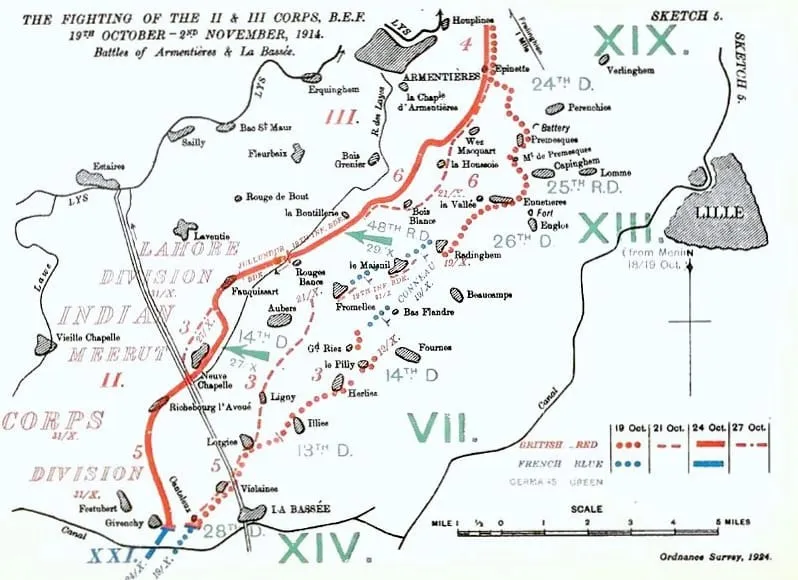
The Battle of Armentières was fought from 13 October to 2 November 1914 in French Flanders, in the valley of the river Lys. It was fought mainly by the British III Corps of General William Pulteney. In the first week the British went over to the attack, took Meteren, entered Bailleul, crossed the Lys and occupied Armentières. They could not, however, reach Lille. From 20 October superior German forces compelled them to go on the defensive, and until the end of the battle III Corps beat off successive attacks east of the town. The line that settled here at that time survived almost unchanged until the spring of 1918.
Name and dates
The name and dates of the battle were fixed after the war by the British Battles Nomenclature Committee. Its sector ran from the Estaires–Fournes line in the south, where it bordered on the Battle of La Bassée, to the small river Douve in the north, where the sector of the Battle of Messines began. The British official history itself considered this division arbitrary. Its authors pointed out that from 19 October the fighting at Armentières was in practice part of the great battle for Ypres, and that heavy fighting on the 4th Division’s sector continued after 2 November as well. The Germans called the fighting on this sector the Battle of Lille until 28 October.
Background
At the beginning of October the British Expeditionary Force left the Aisne front and moved north, to the left flank of the French armies. III Corps, made up of the 4th and 6th Divisions, detrained at Saint-Omer on 10 and 11 October. From there, partly in French buses, it moved on 12 October to Hazebrouck, which German cavalry had reached a few days earlier. Together with Allenby’s cavalry the British were to advance east, north of Lille, and outflank the German wing.
Facing them were the divisions of the German IV Cavalry Corps, reinforced with Jäger battalions and infantry. On the hills around Bailleul and Meteren they were to delay the Allied advance until the German infantry arrived. It was already close. On 12 October the Germans occupied Lille, and the Saxon XIX Corps of General Maximilian von Laffert and the Württemberg XIII Corps were approaching the area.
Course of the fighting
13 October. III Corps set off east from Hazebrouck. Beyond the Meterenbecque stream its advanced guards ran into entrenched Germans. General Pulteney ordered an attack by the whole corps on a front of about eight kilometres, which the British official history calls the first deliberate British attack of the war. It did not start until about 2 p.m. The day was rainy and misty, and dense buildings and hop fields made artillery support difficult. Only after dark did the 10th Brigade take the village of Méteren, and the 18th Brigade neighbouring Outtersteene. III Corps lost 708 men that day. Among the badly wounded was a young lieutenant, Bernard Montgomery, the future field marshal.
14–17 October. During the night the Germans withdrew behind the Lys. On the afternoon of 14 October the British entered Bailleul. On the night of 15–16 October they seized the bridges over the Lys at Sailly, Bac-Saint-Maur and Erquinghem, and on 16 October also at Pont de Nieppe. On 17 October the 10th Brigade entered Armentières. The town, full of refugees from Lille, had been hastily abandoned by the Germans, though small groups of soldiers were still holding out in the houses. The British also occupied nearby Houplines and Ploegsteert on the Belgian side of the border. The prisoners taken belonged to the infantry of XIX and XIII Corps. This meant that the German cavalry had already been relieved by infantry.
18–19 October. III Corps tried to advance further east, towards the low Pérenchies ridge, which screened the approach to Lille. Progress was small. The Germans were already too strong here, and north of Ypres their new corps, prepared for a great offensive, were arriving.
20–25 October. On 20 October the Germans went over to the attack along the whole front from La Bassée to the sea. After heavy artillery fire they struck at the forward positions of the 6th Division. They took the villages of Ennetières and Prémesques, and the hardest-hit 18th Brigade lost more than a thousand men. During the night the division fell back to a shorter line, a few kilometres closer to Armentières. Over the following days the Germans attacked Le Gheer and Ploegsteert Wood on the 4th Division’s sector, and the village of Le Maisnil, defended by French cavalry and the British 19th Brigade, which had to withdraw. The 16th Brigade also fought hard, defending a forward salient at Le Quesne, which it abandoned on the night of 25–26 October.
26 October – 2 November. The fighting took on a static character. Both sides shelled each other, and snipers hunted anyone who raised his head above the trench. The British beat off further German attacks at the end of October. From 30 October the fighting north of the Lys merged with the German attack on the Messines ridge.
Losses
Exact losses are hard to separate from those in the neighbouring battles. According to tallies based on the British official history, III Corps lost nearly 6,000 killed, wounded and missing in the second half of October, most of them from the 6th Division. German losses on this sector were probably even higher.
Significance
The Battle of Armentières closed the last gap in the front south of Ypres. The British did not outflank the Germans and did not recover Lille, which remained under occupation until October 1918. They did, however, stop the German advance on the Lys line and held Armentières. For the following years the town lay a few kilometres from the front, constantly shelled, but it remained in British hands until the German offensive on the Lys in April 1918. It was on this very sector, between Armentières and Ploegsteert Wood, that British and Saxon soldiers concluded one of the best-known Christmas truces in December 1914.
Spotted a mistake?Report an error