Key event
Execution of Mata Hari
- Category:
- Society
- Date:
- 15 October 1917
- Author:
- Natalia
- Tags:
- France, Germany, Netherlands, intelligence
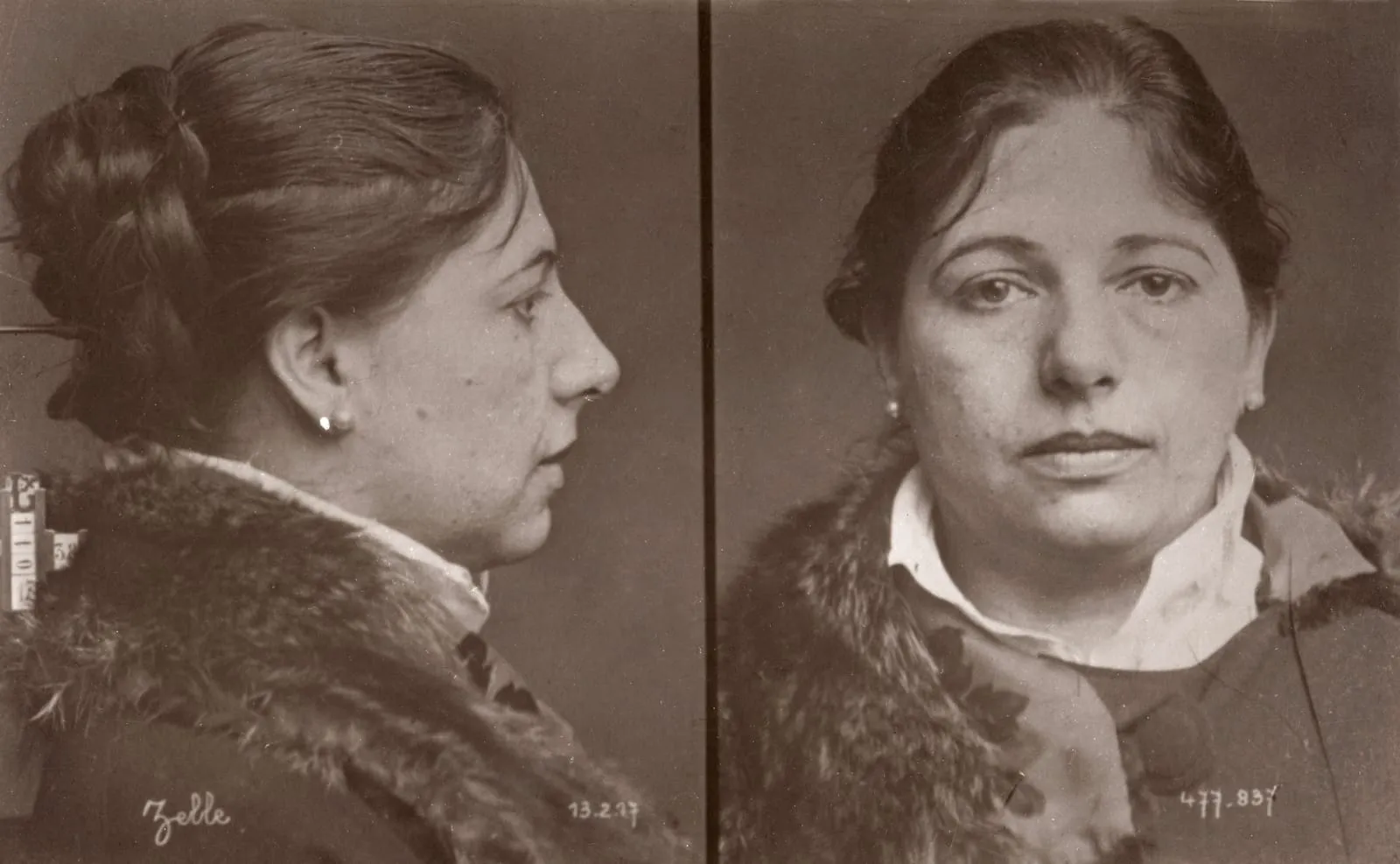
Before dawn on 15 October 1917, in the Saint-Lazare women’s prison in Paris, 41-year-old Margaretha Geertruida Zelle, known throughout Europe as Mata Hari, was woken. Into her cell came the examining magistrate Captain Pierre Bouchardon, her lawyer Édouard Clunet, the Protestant prison chaplain Pastor Jules Arboux and two nuns. Only then did she learn that the President had rejected her plea for clemency and that she was about to be shot. According to the account of the American journalist Henry Wales of the International News Service, who was present at the execution, she asked only whether she might write two letters. She wrote them hastily on the edge of her bunk and handed them to her lawyer. Then she dressed with care, put on a long fur-trimmed coat, a large hat and gloves, and said: “I am ready.”
A car drove through a still-sleeping Paris to the training ground by the fort of Vincennes. A detachment of troops was waiting there, together with a firing squad of twelve soldiers, according to most accounts Zouaves. Mata Hari refused a blindfold. Wales wrote that she was not tied to the stake either. Other witnesses recalled a rope loosely encircling her waist, and some later accounts add that she blew the soldiers a kiss, which can no longer be verified. At about 6.15 a.m. an officer lowered his sabre and the squad fired a volley. Mata Hari sank to her knees and then fell backwards. A non-commissioned officer finished her off with a revolver shot to the head. No one from her family claimed the body, so it was handed over to the Paris medical school.
The dancer from Friesland
Margaretha Zelle was born on 7 August 1876 in Leeuwarden in the northern Netherlands, into the prosperous family of a merchant who soon went bankrupt. At eighteen she answered a matrimonial advertisement and in July 1895 married Rudolf MacLeod, a colonial army officer twenty years her senior. She went with him to Java in the Dutch East Indies. The marriage was unhappy, and in 1899 their little son died. After returning to Europe in 1902 the couple separated, and their daughter stayed with her father.
In 1903 Margaretha went to Paris. On 13 March 1905 she performed in the library of the Musée Guimet, converted into a Hindu temple, as a Javanese temple dancer called Mata Hari, which in Malay means “sun”, literally “eye of the day”. The dance, in which she gradually shed one veil after another, was a sensation. The press eagerly repeated invented stories about her exotic origins, and she herself encouraged them. For several years she performed in the biggest cities of Europe, but after 1910 her fame faded, because numerous imitators appeared and critics increasingly complained that she could not really dance. More and more she lived as a courtesan of wealthy protectors, among whom there was no shortage of politicians and senior officers of various nationalities.
Agent of two intelligence services
The outbreak of war found her in Berlin, where she was due to perform in the autumn of 1914. She returned to the neutral Netherlands penniless, her furs and luggage left behind in Germany. She lived in The Hague, but as a citizen of a neutral state she could travel to France, though because of the front she had to go the long way round, through Britain or through Spain. It was precisely this that attracted the attention of German intelligence. The German consul in Amsterdam, Carl Cremer, offered her 20,000 francs for information from Paris, gave her three small bottles of invisible ink and assigned her the code name H-21. Exactly when this happened is not known. Some researchers, relying on a post-war report of German military intelligence, point to the autumn of 1915, while Mata Hari herself later testified that Cremer visited her in the spring of 1916. She claimed that she took the money as compensation for the furs held in Berlin and threw the bottles overboard. The head of one of the German intelligence schools, Elsbeth Schragmüller, wrote years later that none of the messages sent by H-21 had been of any use.
In the summer of 1916 Mata Hari fell in love with a young Russian officer, Vadim Maslov, from the brigades Russia had sent to France. She wanted to visit him at the spa of Vittel in the Vosges, near the front, where foreigners could not go without a permit. To obtain a pass she approached Captain Georges Ladoux, head of French counter-intelligence at the Ministry of War. The French had already been watching her for several months, because the British regarded her as suspect. Ladoux proposed that she spy for France. She accepted the offer and demanded, as she herself said, a million francs for information from the German high command. She never received the money.
In November 1916, on her way from Spain to the Netherlands, the British detained her in the port of Falmouth, having taken her for the German agent Clara Benedix. In London she was questioned by Basil Thomson, Assistant Commissioner of the Metropolitan Police, who directed the fight against spies at Scotland Yard. She told him that she was working for French intelligence. The British found nothing incriminating on her and sent her back to Spain. Their files, declassified in 1999, show that they regarded her at most as an inept amateur. In December in Madrid Mata Hari made contact with the German military attaché, Major Arnold Kalle. She drew some information out of him and passed it to the French attaché. Kalle meanwhile sent Berlin a series of telegrams about agent H-21 with such precise details that she was easy to identify. The French intercepted them through the radio station on the Eiffel Tower and decoded them. The telegrams had been sent in a cipher which the Germans probably already believed to be broken. That is why some historians suspect that Kalle deliberately wanted to get rid of a not very useful agent at the hands of the French.
Investigation and trial
At the beginning of January 1917 Mata Hari returned to Paris. On the morning of 13 February she was arrested at the Élysée Palace hotel on the Champs-Élysées and taken to Saint-Lazare. Captain Bouchardon questioned her more than a dozen times up to June. For two months she denied everything, and the policemen who had followed her every step since June 1916 had been unable to catch her doing anything suspicious. The breakthrough came only with Kalle’s intercepted telegrams, which Ladoux handed to the investigator in April. Mata Hari then admitted that she had taken money from Cremer, but insisted that she had never spied for the Germans and that in Madrid she had been acting for France. Ladoux denied having recruited her. In his final report Bouchardon called her a woman made for the role of a spy, who exploited men without scruple.
The trial before the 3rd Council of War in Paris took place on 24 and 25 July 1917 behind closed doors. She was tried by seven officers, prosecuted by Lieutenant André Mornet and defended by the elderly Clunet, who had known her for years but was unable to undermine the charges. The indictment accused her, among other things, of passing the Germans information about the French army and about preparations for an offensive. The prosecutor portrayed her as a traitor who amused herself while soldiers were dying at the front. Later it was even repeated that her treachery had cost the lives of 50,000 soldiers, although there is no evidence of this whatsoever. After brief deliberation the judges unanimously found her guilty on all eight counts and sentenced her to death. “It is impossible,” she is said to have repeated after the verdict was announced.
Appeals were of no avail. The military court of review rejected hers in August, and the Court of Cassation at the end of September. The Dutch government asked for the sentence to be commuted. The condemned woman herself wrote a long letter to President Raymond Poincaré, arguing that everything she was accused of doing in Spain she had done for France and with the knowledge of the French authorities. Poincaré did not exercise his right of clemency.
The year of spies
The verdict came at a particular moment. In the spring of 1917 the Nivelle offensive had ended in bloody failure, and mutinies broke out in the French army. The country was weary of the war, and the right-wing press was ever more loudly accusing “defeatists” and enemy agents of treason. In the summer came the affair of the newspaper Le Bonnet Rouge, suspected of being financed with German money. It brought down the Interior Minister Louis Malvy and contributed to the fall of the Ribot government. News of Mata Hari’s arrest was released to the press only at the end of June. An exotic dancer, a divorcée and a foreigner, the lover of officers of many armies, she was perfectly suited to be a symbol of treason. The French press greeted her death with satisfaction. Her defenders compared her with the British nurse Edith Cavell, shot by the Germans in 1915, but commentators usually decided the comparison against her: Cavell had helped soldiers of her own side, whereas Mata Hari had supposedly betrayed the country that had taken her in, for money.
The dispute over her guilt
Already after the war doubts began to arise as to whether Mata Hari had been a dangerous spy. The prosecutor André Mornet is said to have admitted years later that there had really been nothing in the case worth making a fuss about. The Dutch biographer Sam Waagenaar argued in 1963 that she was innocent, but in a later book, in 1976, he conceded that she was not entirely so. Today most historians agree that she did take money from the Germans and tried to play a double game, but passed nothing of importance to either side. The British historian Julie Wheelwright put it this way: she passed on nothing that could not have been read in the Spanish newspapers. Her trial rested on circumstantial evidence and on the moral condemnation of a woman who lived in defiance of the conventions of her age. In 2001 the dancer’s home town and the Dutch Mata Hari Foundation unsuccessfully applied to the French Ministry of Justice for the case to be reopened. The French military archives declassified the trial records only on the centenary of the execution.
The legend of Mata Hari took on a life of its own immediately after the volley at Vincennes. Hundreds of books and dozens of films appeared, the most famous of them from 1931, in which she was played by Greta Garbo. Her name became a byword for a beautiful and dangerous seductress spying for a foreign power, a femme fatale, although the real Margaretha Zelle was more a naive victim of the wartime intelligence game than its mistress.
Remember the articles you have read? Only in this browser; nothing is sent anywhere.How it works
Read ·
Spotted a mistake?Report an error
Meanwhile
(04)Elsewhere in the same days.
- 16 October 1917 · AfricaBattle of Mahiwa beginsOn 16 October 1917 Lettow-Vorbeck struck the Nigerian Brigade at Mahiwa. Two of its battalions were surrounded and a third, sent to help, was driven back.
- 17 October 1917 · War at seaAttack on the Norwegian convoyOn 17 October 1917 the German cruisers Brummer and Bremse smashed a convoy from Norway east of Shetland. Two British destroyers and 9 ships were sunk.
- 17 October 1917 · War at seaSinking of the battleship SlavaAt Moon Sound the dreadnought König crippled the Russian battleship Slava. Drawing too much water for the shallow channel, she was blown up by her crew.
- 17 October 1917 · War at seaHospital ship Goorkha damagedOn 17 October 1917 the British hospital ship Goorkha struck a mine off Malta. All 360-odd people on board survived and the ship was towed into port.
Related events
(04)The same battle, people or subject.
- 13 February 1917 · SocietyArrest of Mata HariOn 13 February 1917 French police arrested the dancer Mata Hari in a Paris hotel on suspicion of spying for Germany and locked her up in Saint-Lazare.
- 21 September 1917 · DiplomacyThe Bernstorff affairOn 21 September 1917 Lansing released a cable in which Ambassador Bernstorff asked Berlin for $50,000 to influence Congress. Washington was in uproar.
- 23 October 1917 · PoliticsBarthou becomes foreign ministerOn 23 October 1917 Louis Barthou replaced Alexandre Ribot at the head of French diplomacy. Ribot was brought down by a dispute over German peace feelers.
- 13 November 1917 · PoliticsFall of the Painlevé governmentOn 13 November 1917 the Chamber of Deputies refused Painlevé a postponement of interpellations on the scandals. His cabinet fell after just two months.