Netherlands · The Central Powers
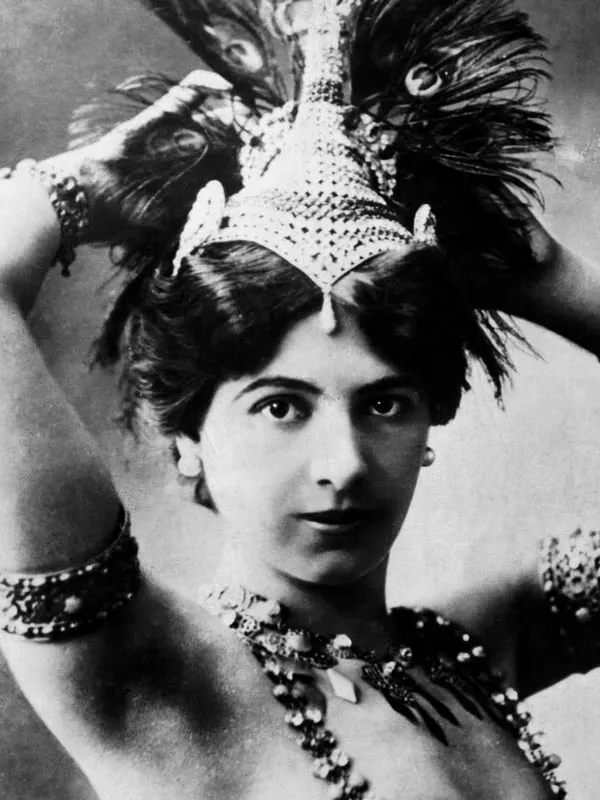
Mata Hari
Dancer and courtesan, agent of German (code name H-21) and French intelligence, shot for espionage (1917)
- Born:
- 7 August 1876, Leeuwarden (Netherlands)
- Died:
- 15 October 1917, Vincennes near Paris
- Author:
- Natalia
- Photo:
- autor nieznany, domena publiczna, Wikimedia Commons

Mata Hari, real name Margaretha Geertruida Zelle, was the most famous woman accused of espionage in the First World War, and perhaps in all history. A Dutchwoman from Friesland, before the war a star of the Paris salons who danced as a supposed Javanese priestess and then lived on the generosity of wealthy lovers, during the war she took money from German intelligence and at the same time offered her services to the French. In February 1917 the French arrested her, in July a court martial sentenced her to death, and on 15 October 1917 she was shot at Vincennes. She was convicted as a German agent, but her guilt is disputed to this day. Most historians believe that she passed nothing of importance to either side, and that she was condemned largely because France in 1917 needed someone to blame.
Before the war
She was born on 7 August 1876 in Leeuwarden in Friesland, the daughter of a well-off merchant who soon went bankrupt. At eighteen she answered a matrimonial advertisement and on 11 July 1895 married Rudolf MacLeod, a captain in the Dutch colonial army twenty years her senior. In 1897 they went out to Java in the Dutch East Indies. They had two children, a son, Norman, and a daughter, Jeanne. The marriage was unhappy, and in 1899 their little son died. After returning to Europe the couple separated in 1902, and the divorce was granted in 1906. The daughter eventually stayed with her father.
In 1903 Margaretha came to Paris with no money and no profession. On 13 March 1905 she appeared in the library of the Musée Guimet, a museum of Asian art, as a Javanese temple dancer called Mata Hari. The name means “sun” in Malay, literally “eye of the day”. The dance, in which she shed one veil after another, was a sensation. Mata Hari told invented stories about her exotic origins, and the press was happy to repeat them. For several years she performed in the great cities of Europe, but after 1910 her fame faded. Imitators appeared, and critics complained that she could not really dance. She lived more and more as a courtesan of wealthy protectors, among them politicians, bankers and officers of various nationalities. These acquaintances were later to be her undoing.
The war and two intelligence services
The outbreak of war found her in Berlin, where she was due to perform in the autumn of 1914. She returned to the neutral Netherlands without money and without her luggage, which stayed in Germany. She settled in The Hague. As a citizen of a neutral country, however, she could travel to France, although because of the front she had to go the long way round, through Britain or through Spain. This caught the attention of German intelligence. The German consul in Amsterdam, Carl Cremer, offered her 20,000 francs for information from Paris, gave her invisible ink and assigned her the code name H-21. When exactly this happened is not certain: some researchers point to the autumn of 1915, while Mata Hari herself testified that Cremer visited her in the spring of 1916. She claimed that she regarded the money as compensation for the furs held back in Berlin and that she threw the ink into the sea. Elsbeth Schragmüller, head of one of the German intelligence schools, wrote years later that none of the reports from H-21 had been of any use.
In the summer of 1916 Mata Hari fell in love with a young Russian officer, Vadim Maslov, of the Russian brigades in France. When Maslov ended up wounded in hospital at Vittel, not far from the front, she applied for a pass to the head of French counter-espionage, Captain Georges Ladoux. The French were already shadowing her, because the British considered her suspect. Ladoux offered her work for France. She accepted and asked, as she put it, for a million francs for information from the German high command. She never received the money.
In November 1916 the British detained her at the port of Falmouth, mistaking her for the German agent Clara Benedix. In London she was questioned by Basil Thomson, Assistant Commissioner of the Metropolitan Police, who directed the fight against spies at Scotland Yard. She told him that she was working for the French. She was sent back to Spain. In Madrid she made contact with the German military attaché, Major Arnold Kalle, drew some information out of him and passed it to the French. Kalle, however, sent Berlin dispatches about agent H-21 from which it was easy to work out who was meant. The French intercepted them through the radio station on the Eiffel Tower. The Germans sent them in a cipher that they probably already believed to be broken, which is why some historians suspect that Kalle wanted to get rid of a not very useful agent.
Arrest, trial and death
On 4 January 1917 Mata Hari returned to Paris. On 13 February she was arrested in a hotel on the Champs-Élysées and locked up in Saint-Lazare prison. The investigation was led by Captain Pierre Bouchardon, who questioned her more than a dozen times. For two months she denied everything. The breakthrough came only with Kalle’s dispatches, which Ladoux passed to the examining magistrate in April. She then admitted that she had taken money from Cremer, but insisted that she had never spied for the Germans and that in Madrid she had been working for France. Ladoux denied having recruited her.
The trial before the 3rd Court Martial in Paris took place behind closed doors on 24 and 25 July 1917. The prosecutor was Lieutenant André Mornet; she was defended by the aged lawyer Édouard Clunet, who had known her for years. The indictment charged her with passing information about the French army to the Germans. The judges unanimously found her guilty on all eight counts and sentenced her to death. Her appeals were rejected, and President Raymond Poincaré declined to exercise his right of pardon, although the Dutch government asked him to.
The verdict came in a year of spy mania. After the failure of the Nivelle offensive and the mutinies in the army, the right-wing press hunted for traitors and German money, and the Bonnet Rouge affair contributed to the fall of the Ribot government. An exotic dancer, a divorcee and a foreigner, the lover of officers of many armies, she was well suited to be a symbol of treason. She was shot at dawn on 15 October 1917 on the training ground at Vincennes. She refused a blindfold. No one in her family claimed the body, which was handed over to the Paris medical school.
After her death
Her daughter Jeanne died in 1919, at the age of 21. Meanwhile her mother’s legend took on a life of its own. Hundreds of books and dozens of films appeared, the most famous of them in 1931, with Greta Garbo in the title role. The name Mata Hari became a byword for a beautiful seductress spying for a foreign power, a femme fatale. Her defenders compared her with the British nurse Edith Cavell, shot by the Germans in 1915. Commentators usually decided the comparison against the Dutchwoman: Cavell had helped soldiers of her own side, while Mata Hari had supposedly betrayed for money the country that had taken her in.
Assessment
Doubts arose soon after the war. The prosecutor Mornet is said to have admitted years later that there had not really been much of a case. The Dutch biographer Sam Waagenaar argued that she was innocent, although he later softened that judgement. Today most historians agree that she took money from the Germans and tried to play a double game, but passed nothing of importance to anyone. The British historian Julie Wheelwright called her the perfect scapegoat for the French, who were losing the war. The trial rested on circumstantial evidence and on the moral condemnation of a woman who lived in defiance of the conventions of her time. In 2001 her home town and the Dutch Mata Hari Foundation asked the French Ministry of Justice, without success, to reopen the case. In 2017, on the centenary of the execution, the French army declassified the case files, 1,275 pages long. The real Margaretha Zelle was more a naive victim of the wartime intelligence game than its mistress.
Sources
Spotted a mistake?Report an error