1914: The Great Retreat
Siege of Maubeuge
- Dates:
- 25 August – 7 September 1914
- Front:
- Western Front
- Location:
- The fortress of Maubeuge on the Sambre, Nord department, FranceOn the battle map →
- Sides:
- FranceJoseph FournierGerman EmpireKarl von Bülow, Hans von Zwehl
- Result:
- German victory. The fortress capitulated and its garrison went into captivity, but the siege delayed the transfer of part of the German forces.
- Author:
- Łukasz Skowroń
The siege of Maubeuge lasted from the last days of August to 7 September 1914. The French fortress on the Sambre, right by the Belgian border, was surrounded by German troops during the Great Retreat of the French and British armies. It held out longer than the Belgian fortresses of Liège and Namur, though it too eventually had to capitulate.
A fortress on the invasion route
Maubeuge was one of the fortresses guarding France’s north-eastern border. The entrenched camp consisted of six forts and several smaller defensive works, placed a few kilometres from the town on a perimeter of about 30 kilometres. Most of the forts, however, dated from the 1880s and were not designed to withstand fire from the heaviest siege guns. The garrison, numbering according to various sources about 45,000–50,000 men, largely older soldiers from territorial units, was commanded by the governor of the fortress, General Joseph Fournier.
In August 1914 the British Expeditionary Force assembled near Maubeuge, and from there it set out for Mons. After the defeats at Charleroi and Mons the British and the French 5th Army retreated south. Field Marshal Sir John French deliberately did not shelter his troops in the fortress, fearing they would be shut up inside it. Maubeuge was left alone.
Encirclement
The British chronology of the war records the encirclement of the fortress under 25 August. On that day, after the fall of Namur, the German 2nd Army of General Karl von Bülow was given the task of cutting off and taking the fortress, and its units began to close the ring from the north-east. More recent studies date the full encirclement to 26–28 August. The siege was entrusted to General Hans von Zwehl and his VII Reserve Corps, reinforced with siege artillery brought from Namur.
Bombardment
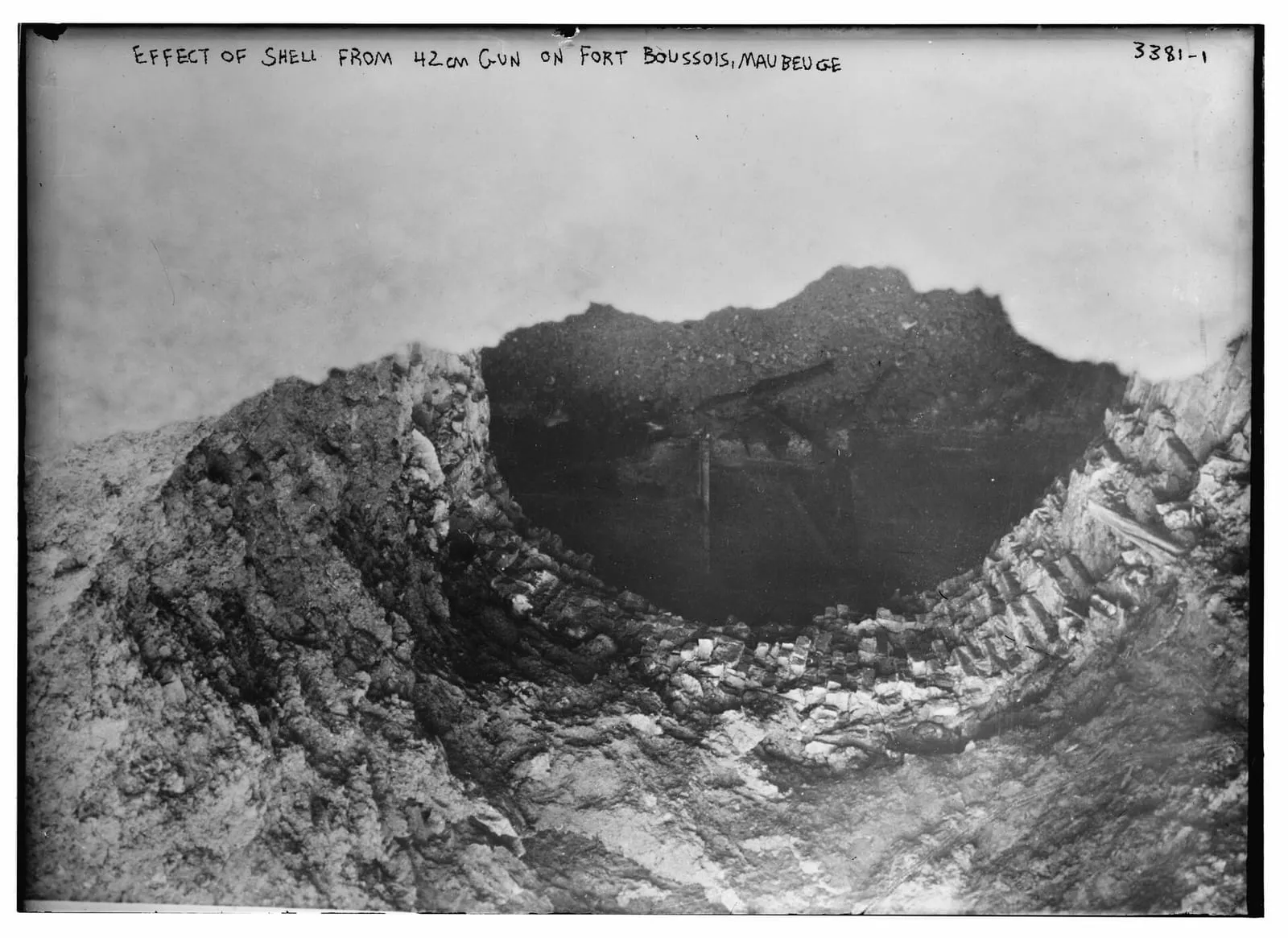
On the afternoon of 29 August the Germans began bombarding the forts on the north-eastern side of the fortress. They used the same weapons as in Belgium: German 420 mm mortars and Austro-Hungarian Škoda 305 mm mortars, as well as numerous smaller-calibre guns. The shells pierced the roofs of the forts, destroying emplacements and killing the defenders. The French garrison attempted sorties but could not break the encirclement.
From 3–4 September the bombardment intensified. One fort and work after another fell, and German infantry forced its way through breaches in the ring of defences. On 7 September, when most of the forts on the north-eastern side had been destroyed, General Fournier asked for a truce and opened negotiations for capitulation. The fortress was handed over to the Germans on 8 September (according to various sources in the morning or at noon).
Losses
Figures for the losses vary by source. On the French side about 1,200–1,300 soldiers were killed and about 3,000 wounded. According to various estimates, from about 32,000–33,000 to more than 40,000 men were taken prisoner. The Germans captured several hundred guns, some of them damaged. German losses are usually estimated at about 1,100 soldiers, though some sources give higher figures.
Significance
Maubeuge fell while the Battle of the Marne was already under way. Its resistance nevertheless mattered. For two weeks the fortress tied down considerable German forces and blocked an important railway line from Belgium into France, which hampered the supply of the German right-wing armies. VII Reserve Corps, released only after the capitulation, reached the Aisne on 13 September and managed to close a gap in the German front, but it took no part in the Battle of the Marne.
The fall of Maubeuge was further proof that the old fortresses could not withstand modern siege artillery. A similar fate had earlier befallen Liège, Namur and Longwy, and later befell Antwerp.
Spotted a mistake?Report an error