Key event
Battle of the Gete
- Category:
- Military operations
- Front:
- Western Front
- Date:
- 18 August 1914
- Author:
- Łukasz Skowroń
- Battle:
- Battle of the Gete
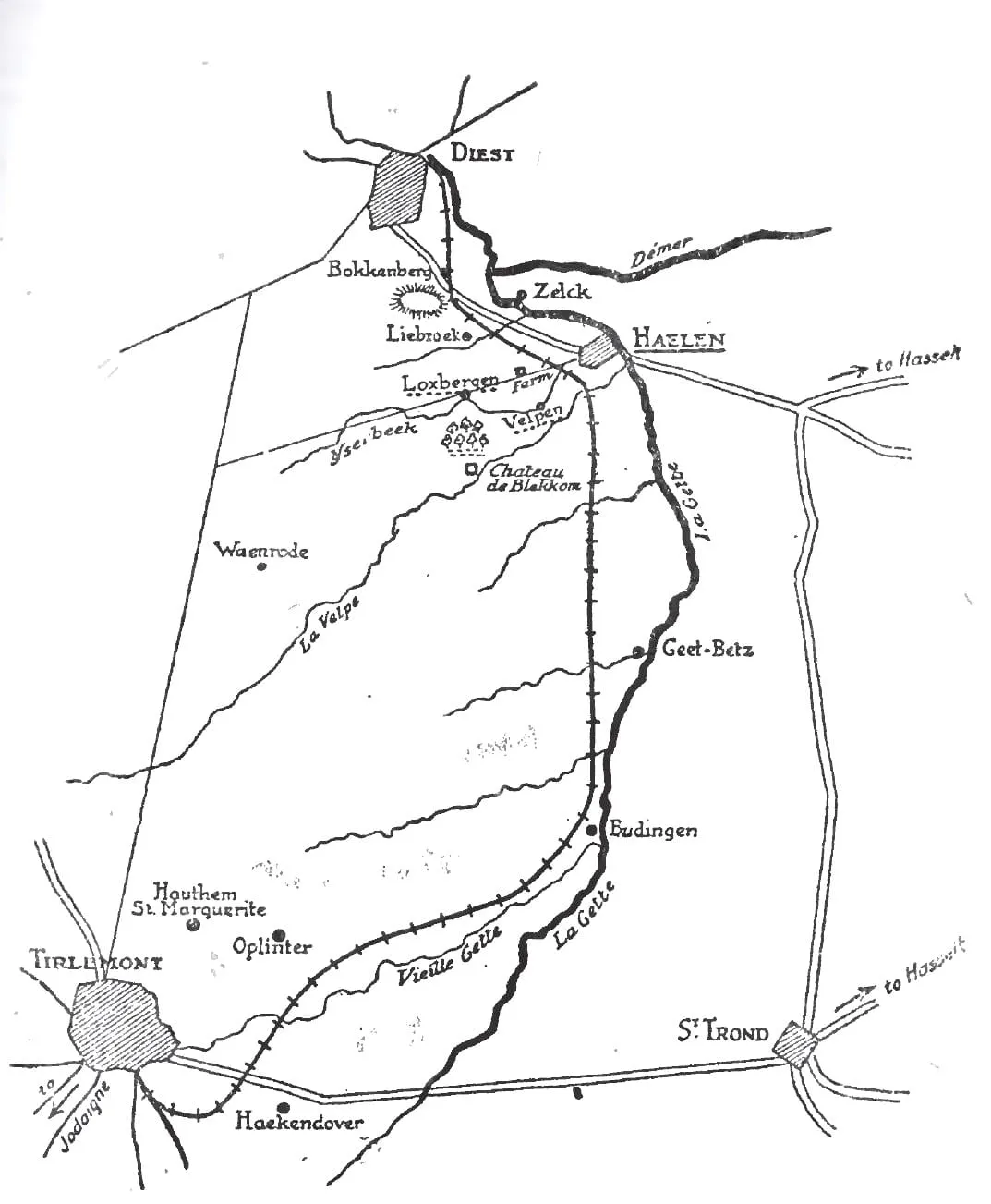
On 18 August 1914, on the river Gete in central Belgium, the Belgian army clashed with the main body of the German First Army. The fighting, which lasted until 19 August, ended a three-week attempt to stop the Germans in the open field. In the evening King Albert I, who commanded the army in person, ordered a retreat to the fortress of Antwerp.
Waiting on the Gete
After the Germans entered Belgium, the field army had assembled by 6 August in the quadrilateral between Tienen, Leuven, Wavre and Perwez, two days’ march west of Liège. The Belgian staff decided to wait there for the French and the British. The line of the Gete, with its left flank resting on the river Demer, covered a large part of the country and Brussels, and at the same time did not cut the army off from Antwerp, where all its supplies had been collected. In the first line, from the area of Tienen (French: Tirlemont) to Jodoigne, stood the 1st and 5th Divisions, with the 3rd Division, back from Liège, between them. The 2nd Division was in the second line near Leuven, the 6th Division further south, and the left flank as far as Diest (PL) was covered by the cavalry division. The 4th Division was defending the fortress of Namur.
From 10 August German cavalry backed by Jäger roamed in front of the Belgian lines. On 12 August six German cavalry regiments with infantry and artillery tried to force the Gete at Halen. The Belgian cavalry division, supported in the afternoon by an infantry brigade, drove them back after a day-long fight in the Battle of Halen. The Belgian official account noted, however, that it was only an episode. When the last forts of Liège fell on 16 August, further German corps were crossing the Meuse, including over the repaired bridge at Huy. The German Supreme Command ordered Alexander von Kluck’s First Army and Karl von Bülow’s Second Army to deal with the Belgian army and force it away from Antwerp. On 17 August, as the Germans drew near, the government left Brussels.
18 August
In the morning the Germans attacked along the whole Belgian front. On the left flank, at seven o’clock, they attacked Budingen and Geetbets, held by two squadrons of the Guides, and at ten their infantry crossed the river. Halen was shelled by artillery, and at Diest two platoons of cyclists and a company of engineers held off an entire brigade for an hour and a half. The cavalry division had to fall back to the north, and the 2nd Division was sent to take its place.
Further south a whole German corps attacked the 1st Division. The Germans took Tienen and struck the positions at Sint-Margriete-Houtem (French: Hautem-Sainte-Marguerite) in front and flank. According to the Belgian official account, the 2nd Brigade held out stubbornly until late in the evening and suffered heavy losses, but enabled the rest of the division to disengage.
The Belgian staff no longer had any illusions. According to the British official history, the German II, IV and IX Corps stood opposite the Belgian left between Diest and Tienen, while the Guard Corps and the VII and X Corps were marching against the right, from Jodoigne to Namur, followed by reserve corps. The Belgians estimated that some half a million men were approaching north of the Meuse. The Belgian army was the size of two army corps, and Allied help was far away. The French Fifth Army was only just coming up to the Sambre, and of the British only the cavalry division had detrained near Maubeuge. Their army was to be ready to march on 22 August at the earliest.
The King’s decision
In the afternoon of 18 August the King decided to withdraw the army to the north-west. At 7.30 p.m. the orders were issued: at dawn the divisions were to cross to the left bank of the river Dyle and take up the line from Neerijse through Leuven to Rotselaar. To stay on the Gete would have meant a battle whose outcome, as the Belgian account put it, was not in doubt. The army would have been attacked in front and on both flanks, and whatever remained of it would have been cut off from Antwerp.
The decision meant giving up Brussels without a fight. The King judged, however, that preserving the army, the state’s only armed force, mattered more than holding the capital. The Belgians also pointed out that for thirteen days, from 5 to 18 August, they had forced the Germans into a wide outflanking movement that had cost the enemy valuable time.
What came next
At dawn on 19 August the rearguard of the 3rd Division fought a hard action at Aarschot against the German II Corps. It became clear that the Germans were outflanking the Belgian left, the line of the Dyle became untenable, and the army made straight for Antwerp. It reached the fortress on 20 August without being seriously troubled by the enemy. That same day the Germans entered Brussels. From the fortress the Belgian army threatened the flank and rear of the Germans marching on France, tying down considerable forces that they later lacked on the Marne. Antwerp held out until October, and after its fall the Belgian army fought on along the Yser.
Remember the articles you have read? Only in this browser; nothing is sent anywhere.How it works
Read ·
Sources
Spotted a mistake?Report an error
Meanwhile
(04)Elsewhere in the same days.
- 17 August 1914 · Balkan FrontBattle of Cer and the Jadar beginsIn mid-August 1914 the Serbian army struck the invaders on Cer mountain and in the Jadar valley. A battle began that brought the Allies their first victory.
- 19 August 1914 · AfricaFirst Indian unit sets out for East AfricaOn 19 August 1914 the 29th Punjabis left India, the first unit of an Indian expeditionary force sent to the front. Its destination was East Africa.
- 19 August 1914 · Middle EastChange of government in PersiaOn 19 August 1914 the Persian Prime Minister Ala al-Saltaneh stepped down and took the foreign ministry. Mostowfi ol-Mamalek became head of government.
- 16 August 1914 · War at seaAustro-Hungarian cruiser Zenta sunkOn 16 August 1914 an Allied fleet surprised the Austro-Hungarian cruiser Zenta off the coast of Montenegro and sank her. 173 sailors were killed.
Related events
(04)The same battle, people or subject.
- 19 August 1914 · Western FrontBelgian army withdraws from the Gete to AntwerpOn 19 August 1914 the Belgian army withdrew from the Gete to the fortress of Antwerp. In the towns it left, German troops committed crimes against civilians.
- 25 August 1914 · Western FrontBattle of Mechelen beginsOn 25 August 1914 the Belgian army sallied out of the fortress of Antwerp and attacked the Germans near Mechelen. It was the first Belgian sortie from Antwerp.
- 27 August 1914 · Western FrontBattle of Mechelen endsOn 27 August 1914 the Belgian army's first sortie from Antwerp ended. After three days of fighting near Mechelen the Belgians returned behind the line of forts.
- 20 August 1914 · Western FrontThe Germans occupy BrusselsOn 20 August 1914 German troops entered Brussels, which had been declared an open city. An occupation began that lasted until November 1918.