Poland · The Polish cause
Józef Dowbor-Muśnicki
Commander of the I Polish Corps in Russia (1917–1918), from January 1919 commander-in-chief of the forces of the Greater Poland uprising
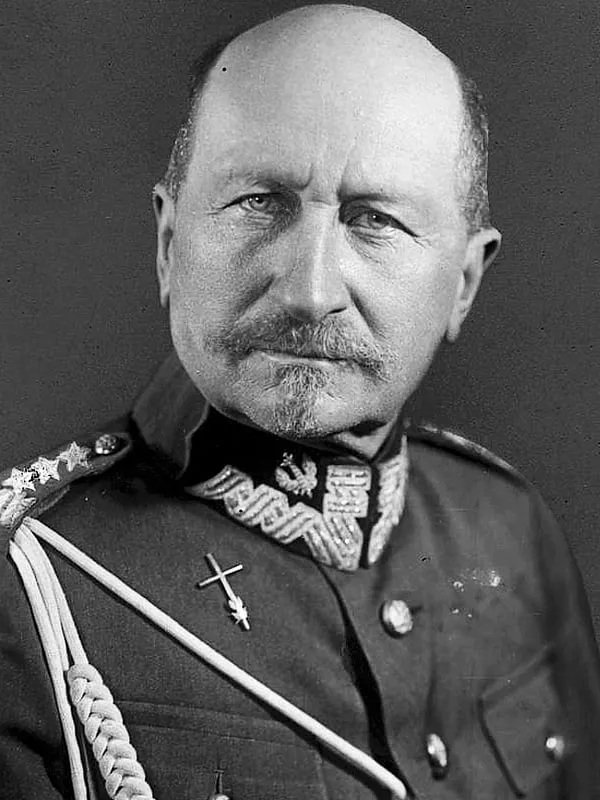
- Born:
- 25 October 1867, Garbów near Sandomierz (Kingdom of Poland)
- Died:
- 26 October 1937, Batorowo near Poznań
- Author:
- Natalia
- Photo:
- autor nieznany, domena publiczna, Wikimedia Commons

Józef Dowbor-Muśnicki was one of several Polish generals of the Tsarist army who after the revolution of 1917 decided to build a Polish army in Russia. His I Polish Corps was the largest Polish formation in the east and, for many contemporaries, the first army since the January Uprising to fight under Polish colours. In January 1918 the corps went to war with the Bolsheviks, took Bobruisk and created a Polish enclave on the Berezina and the Dnieper, called “Dowboria” after its commander. In May, faced with a German ultimatum, Dowbor agreed to disband the corps, for which throughout the interwar period some condemned him while others defended him as a realist who had spared his soldiers’ lives. A year later, at the head of the Greater Poland uprising, he built the regular Greater Poland Army out of volunteer units. Neither in Russia nor in Poland was he a man of Józef Piłsudski’s camp, and this rivalry weighed on his memory.
Before the war
He was born on 25 October 1867 on the Garbów estate near Sandomierz, into the landed Muśnicki family, which descended from the Lithuanian Dowbor clan. His elder brother Konstanty also became a general of the Russian army. Józef attended the gymnasium in Radom, and then the Cadet Corps and the Konstantinovsky Military School in St Petersburg, from which he graduated in 1888 as an infantry second lieutenant. He served in Kostroma, in Siberia and in Yaroslavl on the Volga. Because Catholics found the way to the highest posts and to the General Staff Academy closed in the Tsarist army, in 1890 he converted to Calvinism. In 1902 he graduated with distinction from the Nicholas General Staff Academy.
In the Russo-Japanese War he was an officer for special assignments on the staff of the I Siberian Corps. Later he worked on staffs in Harbin, Irkutsk and Kharkov, and in 1912 he became chief of staff of the 7th Infantry Division in Voronezh. He was a typical professional General Staff officer who had spent most of his life far from home and before the war had little to do with Polish politics.
At the front, 1914–1917
With the 7th Division, part of the 5th Army, he went to the Austrian front in August 1914. His biographers credit him with a share in the division’s successes in the Battle of Komarów, for which he received the Golden Weapon of St George, and later in the Battle of Łódź. At the end of November, as a colonel, he took command of the 14th Siberian Rifle Regiment. At its head he fought in February 1915 in the First Battle of Przasnysz and was seriously wounded while crossing the Orzyc at Stary Podoś. For the fighting at the beginning of the war he received the Order of St George, 4th class. In the summer of 1915 he was promoted to major-general.
In 1916–1917 he commanded in turn the 123rd and 38th Infantry Divisions, for a time was chief of staff of the 1st Army, and in the spring of 1917, by then a lieutenant-general, took over the XXXVIII Army Corps in Belarus. He was then a highly regarded line commander, and his later supporters even wrote that he was mentioned among the candidates for high posts in the revolutionary Russian army.
The I Polish Corps
After the February Revolution the Provisional Government agreed to the formation of Polish units. In June 1917 a congress of Polish servicemen in Petrograd set up the Supreme Polish Military Committee (PL), known as Naczpol, which was close to the National Democrats. In July Naczpol offered Dowbor command of the I Polish Corps, which he took over at the beginning of August. The corps was formed in Belarus, between Minsk, Orsha and Smolensk. It was to have three rifle divisions and several tens of thousands of men, but the Russian authorities were slow to transfer Poles and issue equipment, and the Polish left agitated against an army it called a tool of the gentry. In December 1917 the corps numbered about 29,000 soldiers, including a very large number of officers.
Dowbor built it as an old-style army. He allowed no soldiers’ committees, the officers kept their authority, and Russian epaulettes were replaced by Polish rank insignia and eagles. After the October Revolution he announced that the corps would not take part in internal Russian disputes. For the Bolsheviks, however, it was a counter-revolutionary force. The commander-in-chief Nikolai Krylenko demanded the introduction of commissars and elected commanders, and then demobilisation. Dowbor refused, and in mid-January 1918 ordered his scattered units to concentrate in the area of Rogachev, Zhlobin and Bobruisk. When the Bolsheviks began stopping and disarming Polish transports, he issued an ultimatum. On 25 January at noon it expired and the war began, conducted on the Soviet side by Jukums Vācietis. Krylenko declared Dowbor an outlawed “enemy of the revolution”.
Some of the regiments were stopped and disarmed on the way, and according to some authors the strength of the corps fell to about 12,000 men. At the beginning of February, however, the Poles took the fortress of Bobruisk with its depots almost without a fight, which gave the corps a base. In the following weeks they fought at Rogachev, Zhlobin and Osipovichi, and on the night of 19–20 February Polish conspirators and soldiers of the corps briefly took control of Minsk. According to the socialist Mieczysław Niedziałkowski, Dowbor’s units pacified Belarusian villages at that time, which was to turn the Belarusians against the Poles for a long time.
Dowboria
The corps’ position was transformed by the German offensive, which began on 18 February after the talks at Brest-Litovsk broke down. Fighting the Germans was out of the question, and fighting the Bolsheviks held out no prospect of lasting success. Dowbor therefore opened talks and concluded an agreement with the Germans at Bobruisk, dated 25–26 February 1918. The corps was recognised as a neutral force, kept its weapons and received an area between the Dnieper and the Slutsk–Osipovichi railway, where it took over provisional administration. At the beginning of March the general recognised the authority of the Regency Council in Warsaw, hoping that this would protect his army from disarmament, and the corps swore an oath to the authorities of the Kingdom of Poland.
Thus arose “Dowboria”, an enclave of about 19,000 square kilometres according to the Institute of National Remembrance. In March civil administration was taken over by a board chosen by Polish activists of the Minsk region. The Bolshevik decrees abolishing property were annulled, so landowners returned to their estates. In Bobruisk a Polish press appeared, schools and organisations operated, and on 3 May the corps held a great parade. According to the Institute, at the end of April it again numbered as many soldiers as in December. From the start, however, the agreement with the Germans was controversial. The National Democrats and the left accused the general of going over to the German side, and a conspiracy of young officers connected with the Polish Military Organisation formed within the corps.
After the Peace of Brest-Litovsk the Polish force was no longer of use to the Germans. In May the commander of the German 10th Army, General Erich von Falkenhayn, issued an ultimatum: the corps would lay down its arms or be disarmed by force. Under pressure from Berlin the Regency Council withdrew its political patronage of the corps. Dowbor judged that fighting the Germans, many times stronger, would end in a massacre, and that a march east would deliver his soldiers into the hands of the Bolsheviks. On 21 May 1918 General Aleksander Karnicki signed in Minsk, on his behalf, an agreement dissolving the corps, which guaranteed the soldiers free return home. Ten days earlier the Germans had crushed the Polish II Corps at Kaniów.
On the night of 21–22 May the conspirators, among them Leopold Lis-Kula and Przemysław Barthel de Weydenthal (PL), arrested the general and tried to lead the corps into battle against the Germans. The soldiers refused to obey their orders, and in the morning Dowbor regained command. He let the leaders of the putsch go, but publicly accused them of cowardice and of acting for foreign money, and never withdrew that charge. By the beginning of July the Germans had transported about 23,500 soldiers of the corps to the Kingdom. Dowbor left Bobruisk among the last and settled in Staszów.
After the war
On 6 January 1919 the Supreme People’s Council summoned him to Poznań. With Piłsudski’s consent, on 16 January he took over command of the Greater Poland uprising from Major Stanisław Taczak. He introduced conscription, removed soldiers’ councils and officers of radical views from influence over the army, and built the Greater Poland Army (PL), which according to his biographers reached nearly 100,000 men. He supported a march on Pomerania and Danzig, and opposed sending Greater Poland units east. In March 1919 he became a general of arms, and then carried out the incorporation of the Greater Poland Army into the Polish Army. In 1920 he declined further commands offered to him by Piłsudski, and in October he was transferred to the reserve. He settled on the Lusowo estate near Poznań, renamed Batorowo, where he wrote his memoirs and put the corps’ records in order. During the May Coup he sided with the government. He died at Batorowo on 26 October 1937. His daughter Janina was killed at Katyn in 1940, the only woman among the Polish prisoners murdered there.
Assessment
Dowbor-Muśnicki remains a disputed figure. His opponents, especially the Piłsudskiites, accused him of being Russified, of a deal with the Germans and of dishonourably dissolving the corps without a fight. So wrote Melchior Wańkowicz, a participant in the putsch at Bobruisk, and the historian Wacław Lipiński. His supporters, gathered in the interwar Association of Dowbor’s Men, believed that he had spared the blood of soldiers who a few months later were among the first to disarm the Germans in the Kingdom and to form the Polish Army. Some historians accept that in 1918 the general had very little room for manoeuvre, and that the agreement with the Germans was the only way to save the corps from destruction by the Bolsheviks. No one, however, denies his talent as an organiser who twice, in Bobruisk and in Poznań, built a disciplined army in difficult conditions.
In his lifetime he received no Polish state decoration, which his supporters attributed to the hostility of the Sanation camp. The Order of Polonia Restituta was conferred on him posthumously in 1998, and the Order of the White Eagle in 2018, on the centenary of the Greater Poland uprising.
Sources
Spotted a mistake?Report an error