Persia · Neutral states
Ahmad Shah Qajar
Shah of Persia (1909–1925), ruling in his own right from his coronation in July 1914
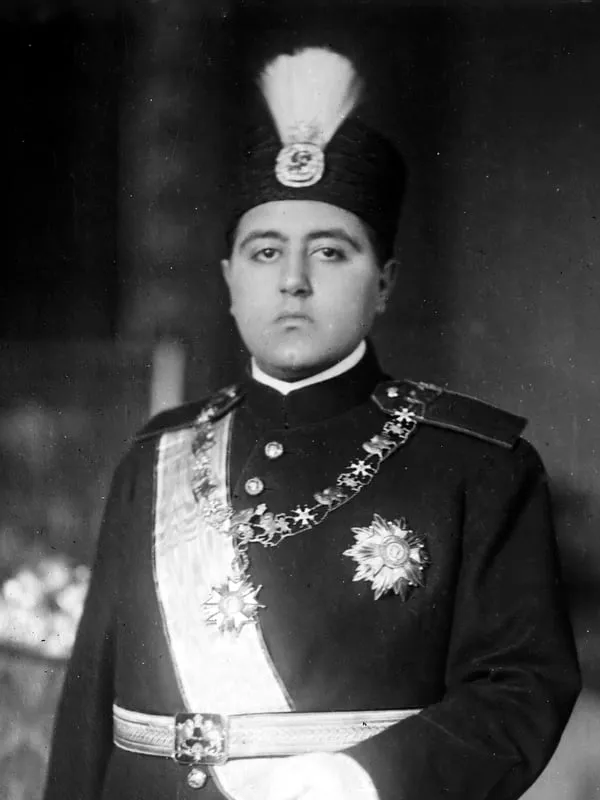
- Born:
- 21 January 1898, Tabriz (Persia)
- Died:
- 21 February 1930, Neuilly-sur-Seine
- Author:
- Natalia
- Photo:
- Bain News Service, domena publiczna, Wikimedia Commons

Ahmad Shah was the last ruler of Persia of the Qajar dynasty. He came to the throne as an eleven-year-old boy, when revolutionaries overthrew his father, and began to rule in his own right in July 1914, a few days before war broke out in Europe. His state declared neutrality but had no strength to defend it: Russians, Turks and British fought on Persian soil, and German agents stirred up the tribes. The young shah manoeuvred between the powers, changed prime ministers every few months and, at the most difficult moment, in November 1915, refused to be drawn out of Tehran by the envoys of the Central Powers. After the war he lost power to Reza Khan, and in 1925 parliament took the throne from his dynasty.
Before the war
He was born on 21 January 1898 in Tabriz, the capital of Persian Azerbaijan. His father, Mohammad Ali Shah, came to the throne in 1907 and set out to destroy the constitution won by the revolution of 1905–1906. In June 1908 he ordered the Persian Cossack Brigade to shell the parliament building, the Majlis, but resistance gathered in Tabriz, Isfahan and Rasht. In July 1909 the constitutionalists took Tehran and on 16 July deposed the shah. In his place the assembly put the eleven-year-old Ahmad on the throne.
Regents ruled in the boy’s name: first his uncle Ali Reza Khan Azod ol-Molk, then Abolqasem Naser ol-Molk, who held the regency until the shah came of age. The state Ahmad inherited was weak and dependent on its neighbours. In 1907 Britain and Russia divided Persia into spheres of influence, and from 1909 Russian troops were stationed in the north of the country. When in December 1911 the Majlis rejected a Russian ultimatum concerning the American treasurer Morgan Shuster, Russian troops moved on Tehran, and the Bakhtiari chiefs, to prevent this, accepted Russia’s demands and dispersed parliament. On 21 July 1914, having come of age, Ahmad was solemnly crowned.
A neutrality nobody respected
A month after the coronation the shah entrusted the government to the respected Mostowfi ol-Mamalek. On 1 November 1914 a decree of the shah proclaimed Persia’s strict neutrality. The neutrality, however, existed mostly on paper. The Russians would not withdraw their troops from the north, the British landed at Fao to protect the oilfields, and in January 1915 Kurds and Turks entered Tabriz, the shah’s home town. In the summer the British occupied Bushehr, where the post office later sold Persian stamps bearing Ahmad’s portrait with an English overprint about the British occupation.
The shah had no army to rely on, so politics came down to the choice of prime ministers. In March 1915 he approved Moshir od-Dowleh, nominated by the Majlis, who wanted genuine neutrality; in April he appointed the old Ain od-Dowleh; and in August Mostowfi again, who negotiated with the Germans. Meanwhile the state was sinking in debt, and in September Britain and Russia agreed to pay it a monthly subsidy so that it would not go over to the Central Powers.
November 1915
The crisis came in the autumn. At the beginning of November a Russian corps gathered at Qazvin, and a rumour spread in the capital that the Russians would enter the city and seize the shah. Democratic deputies, journalists and part of the gendarmerie left for Qom. Prime Minister Mostowfi leaned towards moving the capital to Isfahan, and according to the Encyclopaedia Iranica the shah even issued orders to that effect. The German envoy, Prince Heinrich XXXI Reuss, had already signed a draft of a secret alliance under which Persia was to declare war on Russia and Britain, but the shah’s signature was missing from the document.
On 15 November the envoys of the Central Powers left Tehran and waited for Ahmad at a shrine outside the city. The seventeen-year-old monarch hesitated for a long time. The British and Russian envoys, Charles Marling and Nikolai von Etter, warned him that if he joined the representatives of the enemy powers he might lose his throne. Princes of the Qajar house also urged him to stay, above all the pro-British Abdol-Hossein Mirza Farmanfarma. According to Percy Sykes, the shah panicked again during the night and wanted to ride off to join the Germans, but Farmanfarma prevented it. Ahmad stayed in the capital, and the German plan to draw Persia into the war collapsed. In December Farmanfarma became prime minister, and the émigrés set up a pro-German provisional government in Kermanshah.
The shah between the powers (1916–1918)
After the crisis Tehran came under the overwhelming influence of the Entente. In August 1916 Vosugh od-Dowleh, who was close to the British, became prime minister; the shah never had good relations with him. After his resignation in May 1917 Ahmad appointed in turn Ala al-Saltaneh, Ain od-Dowleh again, Mostowfi and the Bakhtiari chief Samsam ol-Saltaneh. Famine engulfed the country in these years, and after the Russian revolution the British took the Russians’ place with General Dunsterville’s mission.
In the summer of 1918 the shah changed sides. Percy Sykes’s forces defeated their opponents in Fars, the British secured the road to the Caspian Sea, and the Germans were retreating in France. According to Persian accounts Ahmad summoned Samsam to the Golestan Palace and ordered him to resign, and on 7 August Vosugh became prime minister again. The British official history wrote that the shah had dismissed an “anti-British government”. It was this cabinet that was in office in Tehran at the end of the war.
After the war
In August 1919 Vosugh’s government concluded an agreement with Britain which its opponents regarded as the establishment of a British protectorate. In the same month the shah left on a long journey to Europe, arranged with the help of the British envoy Percy Cox. India Office papers show that the journey carried clear political weight, above all for Anglo-Persian relations and the new agreement. Ahmad did not return to Tehran until 3 June 1920. The Majlis never ratified the agreement.
In February 1921 Reza Khan, an officer of the Persian Cossack Brigade, occupied Tehran and pushed the shah aside from real power. In 1923 Ahmad appointed him prime minister and left for Europe, never to return. In October 1925 the Majlis deposed him and declared the end of the Qajar dynasty, and in December an assembly proclaimed Reza Pahlavi shah. Ahmad died on 21 February 1930 at Neuilly-sur-Seine near Paris and, in accordance with his wishes, was buried in the family tomb in Karbala.
Assessment
Ahmad Shah has had a poor press both among his contemporaries and among historians. He was described as a pleasure-loving and incompetent ruler who showed little interest in affairs of state. The occupation of Persia by the Russians, British and Turks dealt the authority of the Qajars a blow from which Ahmad never restored it. At the same time it is acknowledged that he tried to repair the damage done by his father by appointing the best ministers he could find. His most important decision during the war was not to follow the Germans in November 1915. Persia remained formally neutral, but paid for it by having its fate decided by foreign armies and foreign legations.
Sources
Spotted a mistake?Report an error