United Kingdom · The Entente
James Connolly
Leader of the Irish Citizen Army (1914–1916), commander of the rebel forces in Dublin during the Easter Rising (1916)
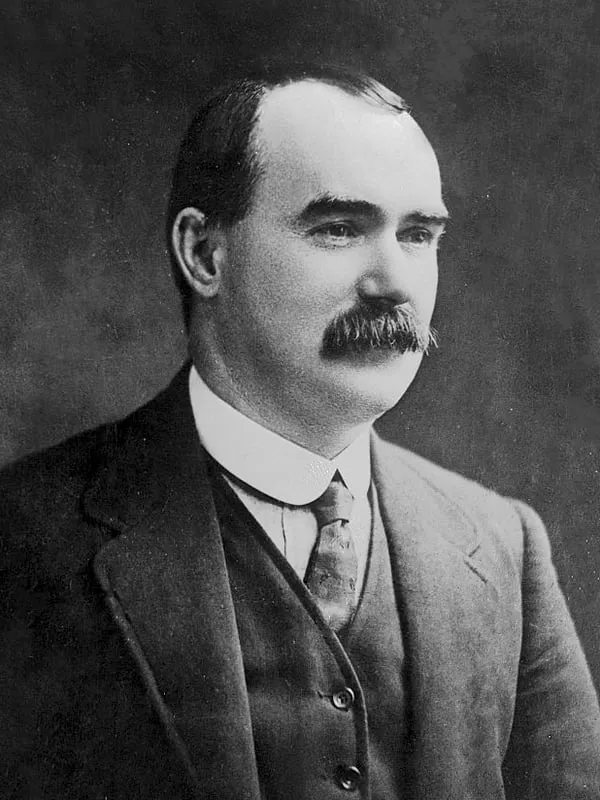
- Born:
- 5 June 1868, Edinburgh (Scotland)
- Died:
- 12 May 1916, Dublin (Kilmainham Gaol)
- Author:
- Łukasz Skowroń
- Photo:
- autor nieznany, domena publiczna, Wikimedia Commons

James Connolly was the only prominent Marxist among the leaders of the Easter Rising, and at the same time the commander of his own, if small, workers’ militia. The son of Irish emigrants from a working-class district of Edinburgh, self-taught, a journalist and trade union organiser in Scotland, Ireland and the United States, from the first days of the war he urged the Irish to exploit Britain’s commitment on the Continent to fight for independence. In January 1916 he joined the conspirators of the Irish Republican Brotherhood, signed the Proclamation of the Irish Republic and during the rising commanded all the rebel forces in Dublin. Badly wounded, he was shot last of the leaders, tied to a chair, which provoked outrage even among opponents of the rising.
Before the war
He was born on 5 June 1868 in Edinburgh, in the Cowgate district, known as “Little Ireland”. His parents were poor emigrants from Ulster, and his father worked as a labourer for the city. Connolly hardly went to school and earned his living from childhood. According to his biographers, as a teenager he enlisted in the British Army under an assumed name and served in Ireland, but there are no documents to prove it. After returning to Scotland he married Lillie Reynolds and became involved in the socialist movement.
In 1896 he came to Dublin as the paid secretary of a local socialist club and founded the Irish Socialist Republican Party, the first party to combine socialism with the demand for full independence. He wrote that if the English army were removed from Ireland tomorrow and the green flag hoisted over Dublin Castle, but no socialist republic were built, England would still rule the country through her capitalists and landlords. The party, however, won no support, and in 1903 Connolly left for the United States. There he worked as a labourer and insurance agent, was an organiser for the revolutionary trade union the Industrial Workers of the World (IWW) and founded the Irish Socialist Federation. In 1910 he published the book Labour in Irish History, in which he presented the history of Ireland as a history of class struggle.
That same year he returned to Ireland, and in 1911 he became an organiser in Belfast for James Larkin’s Irish Transport and General Workers’ Union (ITGWU), where he organised dockers and women linen-mill workers. In 1913 Larkin brought him to Dublin, where employers led by the businessman William Martin Murphy were dismissing union members. The months-long lockout affected tens of thousands of workers and their families, and ended at the beginning of 1914 in defeat for the union. In November 1913 the Irish Citizen Army was formed to protect strikers from the police, a workers’ militia based at Liberty Hall, the union’s headquarters.
Against the war
When Larkin left for America in October 1914, Connolly took over the leadership of the union and the Citizen Army. From the first days of the war he condemned it as a “fratricidal slaughter” of workers for the benefit of capitalists, and attacked the leader of the Irish Parliamentary Party, John Redmond, who was calling on the Irish to join the British Army. A banner was hung on the front of Liberty Hall with the slogan “We serve neither King nor Kaiser, but Ireland”. Connolly headed the Irish Neutrality League, campaigned against recruiting and warned against conscription, which the government might extend to Ireland. He also wrote that if Kaiser Wilhelm II sent an army to Ireland, the Irish would be fully entitled to join it. In December 1914 the authorities shut down his newspaper, the Irish Worker. From May 1915 he published the Workers’ Republic, in which he called ever more openly for a rising. In December 1915 he wrote that in ordinary times he believed in constitutional action, but these times were exceptional and required revolutionary action.
The Citizen Army numbered only about two hundred men, but it was well trained and, unlike the far more numerous Irish Volunteers, openly announced that it would fight. Connolly led it on night manoeuvres in the centre of Dublin, including near the Castle, the seat of the British administration.
The Military Council
The conspirators of the Irish Republican Brotherhood, who had been preparing a rising since the autumn of 1914, feared that Connolly would act alone and provoke the authorities into crushing the whole movement. At the end of January 1916 they met him and, after several days of talks about which legends later circulated, let him into their plans. Connolly joined the Brotherhood’s secret Military Council, and his Citizen Army was to fight alongside the Volunteers. According to accounts by his men, before the rising he told them that they were fighting not only for political but also for economic freedom, and that if they won they were not to give up their rifles.
When on Good Friday the German arms were lost and Roger Casement was arrested, the Volunteers’ leader Eoin MacNeill countermanded the manoeuvres planned for Sunday. The Military Council met on Sunday morning at Liberty Hall and decided to fight a day later. The Volunteers and the Citizen Army formed a joint Army of the Irish Republic. Patrick Pearse became commander-in-chief and president of the provisional government, and Connolly commander of the forces in Dublin.
The rising
On Easter Monday, 24 April 1916, Connolly led a column from Liberty Hall that seized the General Post Office in Sackville Street. He was one of the seven signatories of the Proclamation of the Irish Republic and, according to most historians, influenced its final wording, especially the promise of equal rights and equal opportunities for all citizens. Over the Imperial Hotel, owned by Murphy, his men raised the labour movement’s flag bearing the Plough constellation, the Starry Plough.
From the Post Office he directed the defence of the whole city centre. According to some accounts he assumed that the British would not use artillery in a city in which they had so many interests and so much property of their own. He miscalculated: from Wednesday guns shelled the rebel positions, and a gunboat on the Liffey shelled the already abandoned Liberty Hall. On Thursday 27 April, when martial law was already in force in the city, Connolly was wounded twice, the second time badly in the leg, with the bone shattered. He went on giving orders lying on a stretcher. On Friday the burning Post Office had to be abandoned, and its garrison moved into houses in Moore Street. On Saturday 29 April the leaders decided to stop fighting to spare the civilian population. Pearse surrendered unconditionally, and Connolly countersigned the order to lay down arms on behalf of the units he commanded.
Trial and execution
The wounded Connolly was placed in the military hospital in Dublin Castle. There, on 9 May, he was tried by court martial. He did not defend himself, only rebutting the charge of cruel treatment of prisoners. In a statement he wrote that the rebels had gone out to break Ireland’s connection with the British Empire and to establish a republic, and had proved that Irishmen were ready to die for the same national rights that the British government was asking them to fight for in defence of Belgium. He was sentenced to death.
By then a series of executions was already under way, and opinion in Ireland was changing fast. On the evening of 11 May he was allowed to say goodbye to his wife and daughter. In the early hours of 12 May he was taken on a stretcher to Kilmainham Gaol. He could not stand, so the soldiers tied him to a chair and shot him like that. Before his death he received the sacraments from a Capuchin, Father Aloysius. His body was buried without a coffin in a common pit in the grounds of Arbour Hill military prison. Connolly and Seán Mac Diarmada were the last to be executed in Dublin. Prime Minister Herbert Henry Asquith, who arrived in Ireland that day, halted further executions, but the death of a wounded prisoner became one of the strongest arguments against the British policy of repression.
Assessment
For the Irish labour movement and the left, Connolly is the greatest hero of 1916, and his writings, published in many languages, made him one of the few Marxists who tried to combine the class struggle with the struggle for national liberation. His supporters stress that he understood earlier than others that the world war gave Ireland a chance that might never come again. Critics on the left, already in the 1920s, for instance the writer Seán O’Casey, accused him of abandoning socialism for nationalism in the last months of his life and handing the labour movement over to middle-class conspirators. Other historians point out that his belief that artillery would not be used in Dublin, and his faith in a rising despite the lack of arms, showed poor military judgement.
The assessment of his legacy remains disputed. The rising, which without the support of most Irish people was defeated militarily in less than a week, nevertheless transformed Irish politics within a few years, and Connolly’s execution played a special part in that transformation. Even so, the Ireland born of the struggle for independence bore no resemblance to the workers’ republic he had dreamed of.
Sources
Spotted a mistake?Report an error
Often appears with
People who appear in the same events.