Japan · The Entente
Masatake Terauchi
Prime Minister of Japan (1916–1918), Governor-General of Korea (1910–1916), field marshal
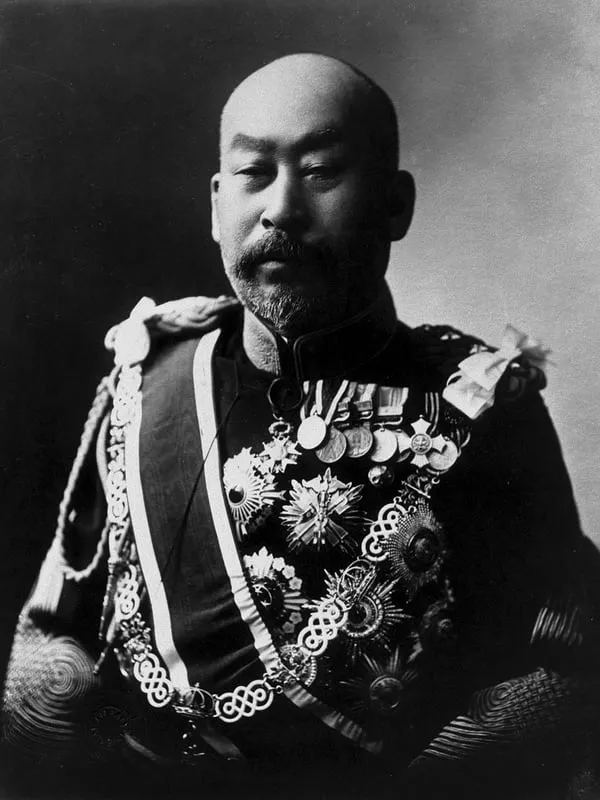
- Born:
- 25 March 1852, Hirai, Suō Province (now Yamaguchi, Japan)
- Died:
- 3 November 1919, Tokyo
- Author:
- Łukasz Skowroń
- Photo:
- autor nieznany, domena publiczna, Wikimedia Commons

Masatake Terauchi was a soldier-administrator from the circle of Field Marshal Aritomo Yamagata, the man who carried out the annexation of Korea and ruled it with a firm hand for six years. In the autumn of 1916 the elder statesmen placed him at the head of a government that rested on no party. His cabinet led Japan through the second half of the war: it sent Japanese destroyers to the Mediterranean in exchange for secret promises concerning Shantung and the Pacific islands, bought itself influence in Peking with loans, concluded an agreement with the United States on China and in August 1918 sent troops to Siberia. A few weeks later he was brought down by the rice riots, and his successor was Japan’s first fully party-based prime minister.
Before the war
He was born on 25 March 1852 (by the lunar calendar, on the 5th day of the intercalary second month) in the village of Hirai in Suō Province, in the Chōshū domain, the third son of the samurai Utada Masasuke. He was adopted by his maternal uncle, from whom he took the surname Terauchi. As a teenager he fought in the Chōshū volunteer units, and then in the Boshin War against the shogunate, right up to the Battle of Hakodate. After the Meiji Restoration he studied soldiering under French instructors and joined the new Imperial Army. In 1877, during the suppression of the Satsuma Rebellion, he was seriously wounded at Tabaruzaka and lost the use of his right arm. From then on he never again held a field command.
Instead, he made a great career in military administration. In 1882–1886 he was in France, first in the suite of Prince Kan’in, then as military attaché. He was commandant of the military academy, in the war with China in 1894–1895 he was in charge of transport and communications at headquarters, and in 1898 he became the first Inspector-General of Military Training. In 1902 he took over the Army Ministry and headed it throughout the war with Russia, and altogether until 1911. In 1907 he was created a viscount.
In May 1910, while keeping the ministry, he became the last Resident-General in Korea. In August he carried out its annexation and, as the first Governor-General, ruled it until 1916. His rule, which relied on military gendarmerie performing police duties, is called by Koreans and historians “rule by the sword”. Terauchi built railways, ports and schools, but the assimilation programme, censorship and a land ownership reform that benefited above all the Japanese aroused hatred in Korea. In 1911 he was created a count, and in June 1916 he was made a field marshal.
The “Billiken” prime minister
When the government of Shigenobu Ōkuma was falling in the autumn of 1916, the outgoing prime minister named as his successor the leader of the Dōshikai party, Takaaki Katō. The genrō ignored this recommendation, and Yamagata pushed through his own protégé. On 9 October 1916 Terauchi became head of the government, also temporarily taking the foreign affairs and finance portfolios. In November he handed diplomacy to Viscount Ichirō Motono, ambassador in Petrograd, and in December finance to Kazue Shōda, a former associate from Korea. Shinpei Gotō became Home Minister.
It was a “transcendental” cabinet, above the parties, made up of bureaucrats and soldiers. The Japanese nicknamed it the Billiken cabinet: the prime minister’s bald head resembled a fashionable doll, and the name sounded like “hirikken”, meaning “unconstitutional”. Katō’s Kenseikai became the opposition, while the government sought support from the Rikken Seiyūkai of Takashi Hara. In January 1917 Terauchi dissolved the lower house, and in the April elections the Seiyūkai again became the largest party. In June the prime minister set up an Advisory Council on Foreign Relations, to which he invited the party leaders. Hara and Tsuyoshi Inukai accepted the invitation; Katō refused.
Ships for Shantung
In war policy Terauchi did not break with his predecessor’s line, but he made the Allies pay for his help. When at the beginning of 1917 the British asked for ships to escort transports in the Mediterranean, Tokyo demanded support for its claims at the future peace conference. In February, just after Germany announced unrestricted submarine warfare, London undertook in a secret note to support Japanese claims to the German rights in Shantung and the Pacific islands north of the equator. France and Russia soon gave similar assurances. In the spring Japanese destroyers reached Malta and escorted Allied transports until the end of the war. The government responded cautiously to requests for more. In November 1917 it refused to send battlecruisers to the Grand Fleet, because the navy did not want to weaken its forces in the Pacific.
Money for Peking
Terauchi’s most personal achievement was his China policy. Instead of open pressure, as with the Twenty-One Demands of 1915, he relied on money and on one man in Peking, Prime Minister Duan Qirui. From January 1917 his private envoy, the businessman Nishihara Kamezō, who had known the prime minister since Korea, negotiated with Duan’s men a series of loans, formally granted by banks but in reality guaranteed by the state. By September 1918 they amounted to about 145 million yen. In return Japan obtained rights to railways, mines and forests in Shantung and Manchuria, while Duan used the money to build up an army. Tokyo also encouraged Peking to enter the war, which it did in August 1917.
The United States watched Japanese expansion in China with concern. In the autumn of 1917 in Washington, Kikujirō Ishii negotiated the Lansing–Ishii Agreement, in which the Americans recognised Japan’s “special interests” in China and both sides reaffirmed the Open Door principle. In May 1918 Terauchi’s government concluded a secret military agreement with Duan, which prepared joint operations in Siberia and gave the Japanese army influence over Chinese troops in northern Manchuria.
Siberia and rice
The revolution in Russia wrecked the policy of close cooperation with Petrograd on which Yamagata and Motono had staked. After the Bolsheviks seized power, Motono and the General Staff, with General Giichi Tanaka, demanded an independent expedition to Siberia. Terauchi decided otherwise. He accepted the arguments of Hara and Yamagata that Japan could not act without the consent of the United States. In January 1918 he ordered only that ships be sent to Vladivostok, and in April sailors landed there to protect Japanese citizens. Motono resigned in April, ill and defeated. Only when, in July, President Woodrow Wilson proposed a joint expedition to help the Czechoslovak Legion did Terauchi’s government, on 2 August 1918, announce the dispatch of troops. Contrary to the arrangements with Washington, the army expanded the Siberian intervention to more than 70,000 men.
The announcement of the expedition coincided with soaring prices. Merchants, counting on army orders, held back sales of rice and prices shot up. In July fishermen’s wives in Toyama Prefecture began to protest, and in August rice riots spread to dozens of towns and villages. The government used more than 100,000 soldiers to restore order, and tens of thousands of people were arrested. The prime minister, ill since the spring, tendered the cabinet’s resignation on 21 September 1918 (some Japanese works give 20 September). Yamagata could find no one among his own men able to govern against the Seiyūkai, and on 29 September Takashi Hara’s government was formed.
After the war
Terauchi never returned to politics. He suffered from heart failure and diabetes. He died on 3 November 1919 in Tokyo, aged 67. Part of his book collection, including materials on Korea, was given to the library he had founded in his home region. His son, Hisaichi Terauchi, also became a field marshal and in the Second World War commanded Japanese forces in South-East Asia.
Assessment
For Koreans Terauchi remained a symbol of the annexation and of the harsh military rule that preceded the outbreak of the national March 1st Movement in 1919. In Japan his cabinet is regarded as the last great government of the old oligarchy. Its fall, forced by street riots, opened the way to party government in the 1920s.
Historians differ in their assessment of his foreign policy. Critics, both Japanese and Western, point out that the Nishihara loans, largely never repaid, were a costly investment in a single Chinese politician which, instead of winning China over, provoked a wave of anti-Japanese feeling there, and that the Siberian intervention brought Japan great costs and American distrust. Others stress that Terauchi was more cautious than his generals, held back an independent expedition to Siberia for half a year and skilfully exploited the needs of the Allies. Thanks to the secret promises of 1917, Japan was able at the Paris Peace Conference to demand and obtain the German rights in Shantung and a mandate over the Pacific islands.
Sources
Spotted a mistake?Report an error
Often appears with
People who appear in the same events.