China · The Entente
Duan Qirui
Premier of the Republic of China (1916–1917, 1917, 1918), head of the War Participation Bureau (1917–1920)
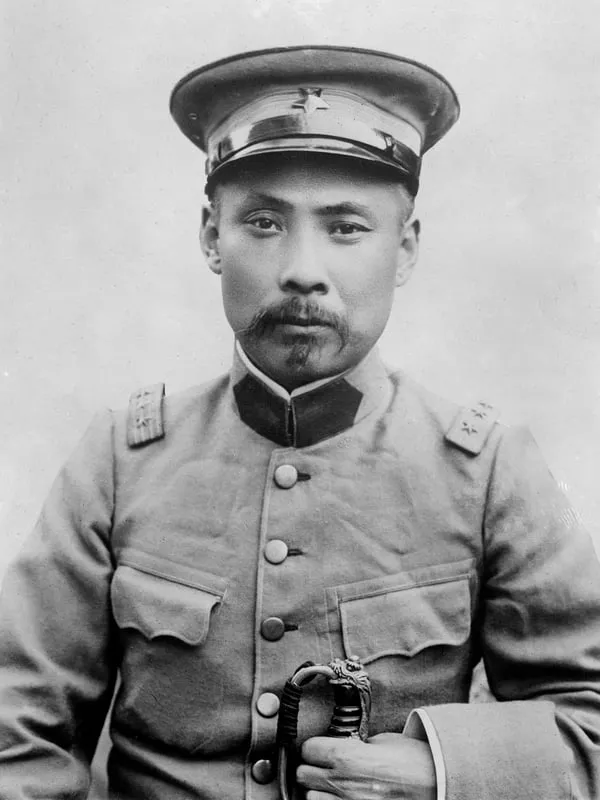
- Born:
- 6 March 1865, Anhui Province (China)
- Died:
- 2 November 1936, Shanghai
- Author:
- Natalia
- Photo:
- autor nieznany, domena publiczna, Wikimedia Commons

Duan Qirui was the strongest man in Beijing in the years when China was entering the Great War. A general of the Beiyang Army and a protégé of Yuan Shikai, after Yuan’s death in 1916 he ruled as premier on behalf of weak presidents, and it was he who forced through the breaking of relations with Germany in March 1917 and the declaration of war on it in August. For him the war was a chance to recover the German rights in Shandong, free China from some of its unequal obligations and obtain money with which he could build his own army and unite the country by force. The money came mainly from Japan, and the secret agreements he concluded in return turned after the war against China and against him personally. The dispute over the war that he unleashed contributed to the split of the state into north and south.
Before the war
He was born on 6 March 1865 in Anhui province. Biographies link him with Hefei, where the family came from, although according to some Chinese works he was born near Lu’an. His grandfather was an officer in the army of Li Hongzhang. In 1885 he entered the military academy in Tianjin, from which he graduated as one of the best artillerymen. At the end of the 1880s he was sent to Germany for military studies, where he attended an officers’ school and trained at the Krupp works in Essen. On his return he attached himself to Yuan Shikai, who in the 1890s was building a modern army on the German model. Duan commanded its artillery and military schools, and in Baoding he ran an officers’ school that produced many of his later followers. Together with Wang Shizhen and Feng Guozhang he was regarded as one of the “three heroes” of the Beiyang Army. Duan’s wife was a ward of Yuan.
During the Xinhai Revolution of 1911 he commanded imperial troops on the Yangtze, but when Yuan came to terms with the republicans, in January 1912 he signed, with other generals, a telegram calling on the court to abdicate. In the republic he was minister of war, and in 1913 he served for a few weeks as acting premier and suppressed the so-called Second Revolution. Over time his influence in the army began to worry Yuan, who was creating his own units loyal to himself. In 1915 Duan, pleading illness, withdrew from the government and did not support the plans of Yuan, who at the end of the year accepted the imperial throne.
Premier after Yuan
When in the spring of 1916 the empire was tottering, Yuan turned to his former associate. In March Duan became chief of the general staff, and in April he took charge of the government, after Yuan had abolished the monarchy. After Yuan’s death on 6 June it was the stance of Duan, the most influential of the generals, that decided that Vice-President Li Yuanhong became president. Many historians believe that Duan preferred a weak president who would be easy to steer. At the end of June, under pressure from the south, he agreed to restore the Provisional Constitution of 1912 and the parliament, and Li reappointed him premier.
The harmony did not last long. Duan believed that the cabinet governed and the president merely signed. Li and the parliament, in which the party of Sun Yat-sen was strong, wanted to control him. The Chinese called this conflict the dispute between the presidential palace and the cabinet. Its most important subject became the war.
The road to war
When in February 1917 the United States broke off relations with Germany and called on neutral countries to follow suit, Duan saw it as an opportunity. The Chinese were also outraged by the sinking of the liner Athos, in which several hundred Chinese labourers travelling to France died. Japan, which since 1914 had occupied Tsingtao, now itself urged Beijing to join the Entente, and the Allies promised to defer the instalments of the Boxer indemnity and to raise customs duties. At the beginning of March Li Yuanhong refused to sign the government’s telegram on the matter. Duan announced his resignation and left for Tianjin, but returned a few days later, and parliament backed his motion. On 14 March China broke off relations with Germany.
The declaration of war proved harder. Parliament delayed, suspecting that the premier was concerned not with international law but with Japanese money and strengthening his own power. In May the parliament building was surrounded by a crowd of so-called “citizens” who threatened the deputies, and the military governors came to Beijing to put pressure on the chambers. The scandal turned against the premier. On 23 May Li Yuanhong dismissed him. Generals loyal to Duan declared “independence” from Beijing and demanded the dissolution of parliament. In this situation General Zhang Xun, called in as a mediator, forced the dissolution of the chambers and on 1 July restored Puyi to the throne.
Duan did not support the restoration. On 3 July at Machang near Tianjin he took command of the northern troops, declared Zhang a traitor and marched on Beijing. Three bombs were dropped from an aircraft on the Forbidden City, and by 12 July the capital was in republican hands and Puyi abdicated again. Duan returned to Beijing as the “defender of the republic”, and Li Yuanhong handed power to Vice-President Feng Guozhang. Some participants in those events claimed years later that Duan’s men had earlier encouraged Zhang to march on Beijing, but these accounts remain disputed. What is certain is that Duan was now the strongest man in the state, and he did not recall the old parliament. On 14 August 1917 China declared war on Germany and Austria-Hungary.
Money from Tokyo
China’s part in the war was above all political and economic. The government took over the German and Austro-Hungarian concessions in Tianjin and Hankou, and tens of thousands of labourers went to France. China sent no soldiers to Europe. For Duan, however, the war provided a pretext for building a new “war participation” army. In December 1917, after losing the premiership, he took over the War Participation Bureau and ran it until 1920.
The money came from Japan. From as early as January 1917 the government of Masatake Terauchi, through a private envoy, Nishihara Kamezō, granted Beijing loans that were formally bank loans but in reality guaranteed by the state. By the autumn of 1918 they amounted, according to most works, to about 145 million yen. In return the Japanese obtained rights to railways, mines and forests in Shandong and Manchuria. Duan’s divisions were formed with Japanese money and under the eye of Japanese instructors. In May 1918 his government concluded with Japan a secret military agreement against the “common enemy” in Siberia, which provoked student protests and accusations that the premier was selling out the country. In the summer of 1918 a small Chinese detachment also sailed to Vladivostok and took part in the intervention in the Russian Far East.
War with the south
Duan regarded the unification of China by force as his overriding aim. When he did not recall the dissolved parliament, Sun Yat-sen and some of the deputies formed a military government in Canton that recognised neither the authorities in Beijing nor their declaration of war. Duan sent troops to Hunan, but generals from Feng Guozhang’s camp, supporters of a settlement with the south, called for a ceasefire in November 1917. On 22 November Duan stepped down as premier. From then on, the rivalry with Feng divided the Beiyang Army into the Anhui clique, grouped around Duan and his right-hand man, General Xu Shuzheng, and the Zhili clique.
In March 1918, after the successes of the northern troops in Hunan, the generals demanded Duan’s return, and on 23 March he became premier again. His faction, the so-called Anfu Club, won the spring elections to a new parliament, recognised only in the north. The compromise that allowed Xu Shichang to be elected president in September, however, required Duan to leave together with Feng. On 10 October 1918, the day of Feng’s resignation, he resigned. He nevertheless kept his army and his influence as head of the War Participation Bureau and patron of the majority in parliament.
After the war
Duan’s calculations failed where they mattered most. At the peace conference in Paris the powers, bound by promises made to Japan in 1917, awarded it the German rights in Shandong. The Japanese invoked the agreements that Duan’s government had concluded with them. In May 1919 protests broke out that gave rise to the May Fourth Movement, and their edge was turned also against ministers associated with the Japanese loans. China did not sign the Treaty of Versailles.
In July 1920 the Zhili clique, backed by Zhang Zuolin, routed Duan’s troops in a few days, and he gave up all his offices and settled in Tianjin. In November 1924, after the coup of Feng Yuxiang, he returned as provisional chief executive, but without an army of his own he was a hostage of the generals. On 18 March 1926 his guard opened fire on demonstrators in Beijing and several dozen people were killed (the 18 March Massacre). A month later he was removed from power. He spent his last years in Tianjin and Shanghai, devoting himself to Buddhism and the game of go. According to Chinese works he rejected offers of collaboration from the Japanese, who after 1931 were looking for compliant politicians in northern China. He died on 2 November 1936 in Shanghai.
Assessment
Duan’s image in historiography is divided. For decades historians in mainland China saw him above all as a militarist who sold out Chinese interests for Japanese money and deepened the civil war. Western scholars point to his contempt for parliament and the constitution, to his rule through a narrow circle of trusted officers, and to the fact that the war with Germany was for him largely a tool in the struggle for power at home. Liang Qichao, who worked with him, nevertheless credited him with taking responsibility for difficult decisions regardless of his own interest, and even his opponents stressed his personal honesty.
Some historians, especially in Taiwan, also appreciate that he three times stood up in defence of the republic: in 1912, during Yuan’s empire, and against Zhang Xun’s restoration. He is also credited with the fact that, thanks to entering the war, China found itself among the victors, recovered the concessions in Tianjin and Hankou, and through the treaty with Austria joined the League of Nations. The heaviest charge remains that, while seeking a place at the victors’ table, he at the same time handed Japan the arguments with which in Paris it took Shandong from China.
Sources
Spotted a mistake?Report an error
Often appears with
People who appear in the same events.