Estonia · The Entente
Konstantin Päts
Chairman of the Estonian provincial government (1917–1918), Prime Minister of the Provisional Government of Estonia (1918–1919)
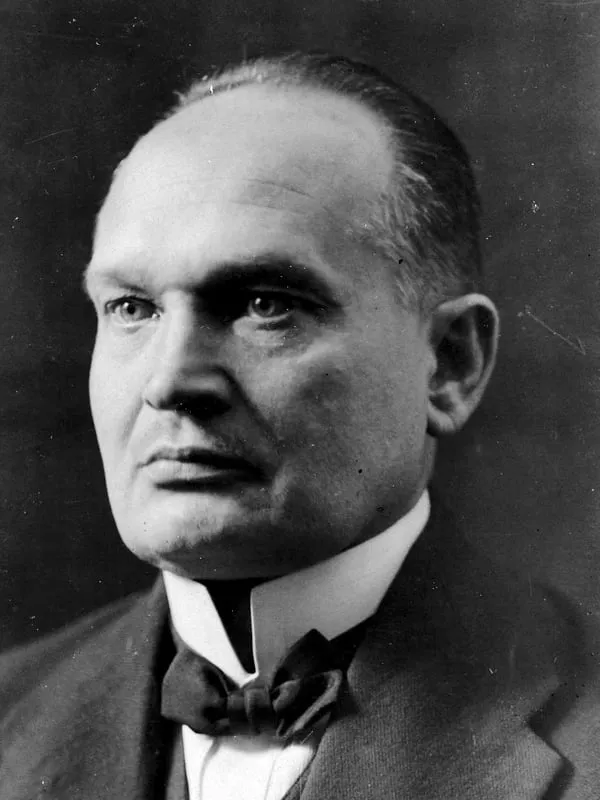
- Born:
- 22 February 1874, Tahkuranna (Estonia)
- Died:
- 18 January 1956, Burashevo (Kalinin Oblast, USSR)
- Author:
- Natalia
- Photo:
- autor nieznany, domena publiczna, Wikimedia Commons

Konstantin Päts was one of the founding fathers of the Estonian state, which was born in the last year of the Great War between two occupations: Bolshevik and German. In 1917 he became head of the government of autonomous Estonia, and in February 1918, as a member of the three-man Salvation Committee, he proclaimed the independence of the republic and became Prime Minister of its Provisional Government. The Germans, who entered Tallinn the next day, recognised neither the state nor the government, and in June they arrested Päts and sent him to a camp. When the Reich lost the war in November 1918, he returned to lead the defence of the country against the Red Army. He looked to the Entente for support: Estonian politicians counted on the support of the Western powers, which were the first to recognise their assembly de facto. The republic itself, proclaimed in February 1918, declared neutrality towards all its neighbours.
Before the war
According to his birth register he was born on 22 February 1874 (10 February Old Style; many works give 23 February) in the village of Tahku in the parish of Tahkuranna near Pärnu. The family was Orthodox, which was rare in Lutheran Estonia, and Päts was educated first in Orthodox schools and then at the theological seminary in Riga. He did not become a priest. He finished the gymnasium in Pärnu and studied law at the University of Dorpat. In 1900 he settled in Tallinn, where he worked in the law office of Jaan Poska, and in 1901 he founded the newspaper Teataja. In it he competed with Jaan Tõnisson, publisher of the Dorpat Postimees, for the leadership of the Estonian national movement. He campaigned to take power in the towns away from the Baltic Germans, and in 1905 he became deputy mayor of Tallinn.
The Revolution of 1905 forced him to flee. After the unrest, in which part of his paper’s editorial staff was involved, he left for Switzerland and then Finland, where he lived under an assumed name. According to Estonian biographers he was sentenced to death in absentia. In 1909 he returned and stood trial before a court which sentenced him only to prison. He served nine months in the Kresty prison in St Petersburg, and during that time his wife died of tuberculosis in Switzerland. From 1911 he edited the newspaper Tallinna Teataja in Tallinn.
War and autonomy
Estonia, then divided between the Governorate of Estonia and the northern part of the Governorate of Livonia, was not a battlefield until 1917, but the war affected it from the start: tens of thousands of Estonians fought in the Russian army, and Tallinn was turned into a naval fortress protecting Petrograd from the west. In 1916 Päts was called up as a reservist. He served in Tallinn in Peter the Great’s Naval Fortress with the rank of ensign.
The February Revolution opened the way to autonomy. In April 1917 the Provisional Government united the lands inhabited by Estonians into a single autonomous Governorate of Estonia, and Poska became the government’s commissar. Päts, who argued for one rather than two autonomous units, won this dispute against Tõnisson. In the summer he chaired the Supreme Committee of Estonian Soldiers, which campaigned for the formation of Estonian national units in the Russian army. These later provided the cadre of the Estonian army. He sat in the provincial assembly elected in the summer, the Maapäev, and in October 1917 he became head of the provincial government (Maavalitsus).
It lasted a few weeks. After the October coup the Bolsheviks took power in Tallinn. On 28 November the Maapäev declared itself the supreme authority in Estonia until a constituent assembly was convened, after which the Bolsheviks dispersed it and its leaders went underground. Päts was briefly imprisoned. In mid-January 1918 the leaders of the Estonian parties decided at a secret meeting to declare independence once the threat of German occupation became imminent. As chairman of the provincial government, Päts signed the credentials of the delegates who were to seek support in Scandinavia, London and Paris.
Independence and occupation
After the breakdown of the talks at Brest, the German army moved east on 18 February. The next day the Council of Elders of the Maapäev handed all power to the three-man Salvation Committee: Päts, Jüri Vilms and Konstantin Konik. The committee wanted to seize the moment when the Russians were fleeing and the Germans had not yet arrived. An attempt to read the manifesto in Haapsalu failed because the Germans took the town that same day, but on the evening of 23 February the manifesto was proclaimed in Pärnu, and on 24 February, when the last representatives of Soviet power had left Tallinn, the committee proclaimed the independent Republic of Estonia in the capital. The same day it appointed a Provisional Government with Päts as Prime Minister and Minister of the Interior.
The next day the Germans entered Tallinn. Päts, Vilms and Poska talked for several hours with a German general, but the occupiers recognised no Estonian authority. They relied on the Baltic landed gentry, which dreamed of a duchy joined to Prussia, and disbanded the Estonian national units. The government went underground, while abroad a delegation with Tõnisson and Ants Piip was at work, and its efforts bore fruit. As early as the end of February London announced its readiness to recognise provisionally the Estonian assembly as an independent body, and in the spring Britain, France and Italy recognised the Maapäev de facto. In April, when the Baltic Germans assembled a united provincial council in Riga, which asked for union with Prussia, rural district elders from southern Estonia read out there a protest prepared by Päts’s government. The Estonians wanted to unite neither with Germany nor with Russia. Vilms was killed in April in Finland in unexplained circumstances. On 16 June the Germans arrested Päts. They held him in several camps and prisons, the last a camp in the Governorate of Grodno.
November 1918
The revolution in Germany opened the way to the revival of the state. On 11 November, the day of the Armistice of Compiègne, the Provisional Government resumed its work in Tallinn under Poska’s chairmanship, and the next day Päts, still imprisoned, was confirmed as Prime Minister. He regained his freedom on 17 November and returned to Tallinn around 20 November. Meanwhile the government called up a volunteer People’s Army, and on 19 November an agreement was signed in Riga under which the Germans handed power over to the Estonians. On 27 November Päts formed a new cabinet in which he also took the war portfolio.
A day later, on 28 November, the Red Army attacked Narva and the Estonian War of Independence began. His government declared mobilisation, asked Britain and Finland for help, and on 23 December appointed Colonel Johan Laidoner commander-in-chief. The turning point came in January 1919: with the help of the British fleet and Finnish volunteers the Estonians went over to the offensive and by the end of February had driven the Red Army out of the country. In May 1919, after the elections to the constituent assembly, in which his party fared poorly, Päts gave up power. In the summer he opposed the war against the German Landeswehr in Latvia, in which the Estonians defeated the troops of General Rüdiger von der Goltz.
After the war
In the 1920s and 1930s he was head of state five times as Riigivanem, State Elder, combining the functions of prime minister and head of state. On 12 March 1934, together with Laidoner, he carried out a coup aimed at the radical veterans’ movement, the so-called Vaps, and began several years of authoritarian rule, known in Estonia as the “Era of Silence”. In 1938 he became the first President of Estonia. In 1939 he agreed to Soviet military bases, and in June 1940, after the occupation of Estonia by the USSR, he signed the decrees of the new authorities. On 30 July 1940 he was deported with his family to Ufa. He spent the rest of his life in Soviet prisons and psychiatric hospitals. He died on 18 January 1956 in the hospital at Burashevo near Kalinin. In 1990 his remains were buried in Tallinn.
Assessment
Päts’s role in 1917–1918 is rated highly in Estonia almost unanimously. He was one of the politicians who, in the chaos of the collapsing empire, understood that it was necessary to forestall both the Bolsheviks and the Germans, and he gave the new state a founding act to which it could later appeal. Historians stress that the Salvation Committee managed within a few days to declare independence in almost impossible conditions, and that in the autumn of 1918 the government, whose members had survived the German occupation underground and in camps, was able to take power immediately. Critics point out that in 1918 Päts was more a politician and organiser than a leader followed by the masses, and that his rivals, especially Tõnisson and the left, held at least an equal position in Estonian politics.
His later career casts a longer shadow over the figure. The 1934 coup and rule without parliament, and above all his submissiveness to Moscow in 1939–1940, remain disputed in Estonia to this day. Some historians defend him, pointing to the country’s hopeless position; others accuse him of weakening the Estonians’ ability to resist through his authoritarian rule. This does not change the fact that in 1918 he stood at the cradle of a state that survived two decades, and 24 February remains Estonia’s national day.
Sources
Spotted a mistake?Report an error