France · The Entente
Marie Skłodowska-Curie
Physicist and chemist, Nobel Prize winner (1903, 1911), director of the Red Cross radiology service in France (1914–1918)
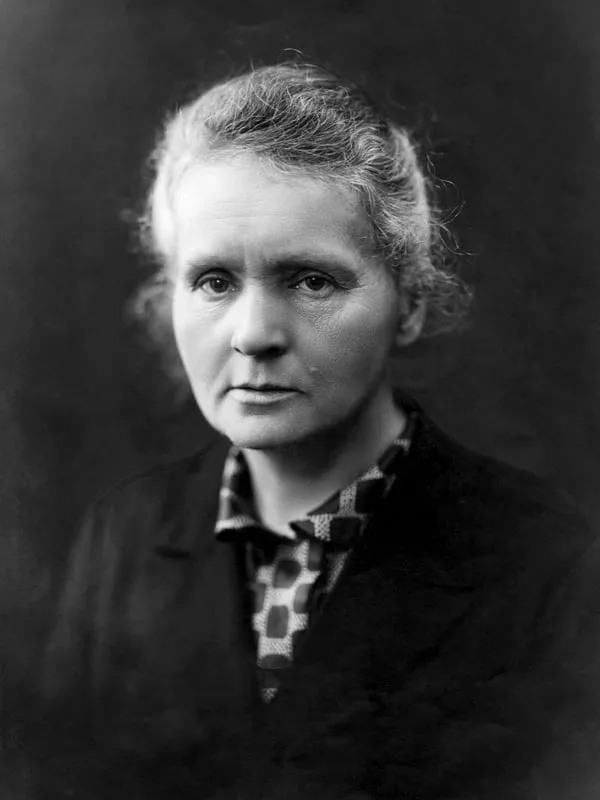
- Born:
- 7 November 1867, Warsaw (Kingdom of Poland)
- Died:
- 4 July 1934, Passy (Haute-Savoie)
- Author:
- Natalia
- Photo:
- Henri Manuel, domena publiczna, Wikimedia Commons

Marie Skłodowska-Curie was the most famous scientist of her time: the discoverer of polonium and radium, the first woman to be awarded the Nobel Prize and the first person to receive it twice. She was born in Warsaw, in the Kingdom of Poland under Russian rule, and from 1891 lived and worked in Paris. When war broke out in 1914, she set her research aside and put her knowledge at the service of the French army. She organised a military radiology service, equipped a fleet of cars with X-ray apparatus, which the soldiers called “little Curies”, and trained women to operate them. Thanks to her work, doctors behind the front could X-ray the wounded instead of searching blindly for bullets and shell splinters. “Unable to serve Poland, she decided to serve France” is how her biographers sum up her stance in those years.
Before the war
She was born on 7 November 1867, the youngest of the five children of two teachers. Her father, Władysław Skłodowski, taught mathematics and physics; her mother, Bronisława née Boguska, ran a boarding school for girls. In the Russian partition women could not attend university, so Maria studied at the clandestine Flying University and worked as a governess, helping to support her elder sister Bronisława, who was studying medicine in Paris. In 1891 she herself left for France and enrolled at the Sorbonne. In 1893 she took her degree in physics, and a year later in mathematics. In 1894 she met the physicist Pierre Curie, and in July 1895 she became his wife.
Together they studied the phenomenon that Marie named radioactivity. In 1898 they announced the discovery of two new elements. They named the first polonium, in honour of Marie’s homeland, which was not on the map, and the second radium. In 1903 the couple shared the Nobel Prize in Physics with Henri Becquerel. In 1906 Pierre was killed under the wheels of a horse-drawn cart, and Marie succeeded him in his chair as the first woman professor at the Sorbonne. In 1911 she received her second Nobel Prize, this time in chemistry. The same year brought her humiliation: the Academy of Sciences rejected her candidacy, and the press unleashed a campaign against her over her relationship with the married physicist Paul Langevin, calling her a “foreigner” who was breaking up a French family. In the summer of 1914 the construction of the Radium Institute, built for her by the University of Paris and the Pasteur Institute, was nearing completion.
Radium in Bordeaux
The war found Marie in Paris and her daughters, seventeen-year-old Irène and ten-year-old Ève, on holiday in Brittany. Her colleagues went into the army, and only a mechanic, turned down by the army because of a heart condition, stayed with her at the new institute. At the beginning of September, as the Germans approached the capital and the government moved to Bordeaux, Curie took there by train, in a heavy lead container, France’s entire research stock of radium, a single gram, and left it in a bank safe. She herself returned to Paris on a military train, because she felt her place was there. She wanted to give her gold Nobel medals to the state’s gold collection, but the Bank of France would not accept them. She put most of her prize money into war bonds. On 1 January 1915 she wrote to Langevin that she was resolved to put all her strength at the service of her adopted country.
“Little Curies”
The scientist quickly saw that the survival of many wounded men depended on whether the surgeon knew where a bullet or a splinter lay in the body. Most hospitals, especially near the front, had no X-ray apparatus. Curie persuaded the authorities to let her set up military radiology units and became director of the Red Cross radiology service. She gathered equipment from Paris laboratories, and the money for the first car came from the Union des Femmes de France. Further vehicles were donated by wealthy acquaintances, workshops converted them into vans, and manufacturers supplied equipment. The current for the X-ray tube came from a dynamo driven by the car’s engine.
The first car was ready at the end of October 1914. In the autumn of that year Curie set off in it for the hospitals behind the front, accompanied by a military doctor and by Irène, her first assistant. She hurriedly taught herself anatomy, how to operate the apparatus, how to drive and car mechanics, and in July 1916 she became one of the first women to obtain a lorry driving licence. In December 1914, at the request of the Belgian army, she drove with her daughter to Furnes, in the strip of Belgium that the Belgians had held in the Battle of the Yser. By the end of the war Curie’s service had about 20 X-ray cars and some 200 permanent units in hospitals. At the end of 1918 Curie calculated that more than 500 fixed and semi-fixed radiology stations and some 300 mobile sets were at work in France. Estimates of the number of wounded examined during the war range from about 900,000 to more than a million.
A school for technicians and radium in the service of medicine
There were so many cars and units that mother and daughter could not run them alone. From 1916 Curie trained women as radiology assistants at the Radium Institute. The courses lasted several weeks and covered electricity, the physics of X-rays, anatomy and photographic processing. According to the most commonly cited figures she trained about 150 women. Irène, who was studying at the Sorbonne at the same time, helped with the teaching, and after a year of practice ran a front-line unit on her own. Neither of them was properly protected from the radiation.
When in 1915 it became clear that Paris was no longer in danger of falling, Curie brought the radium back from Bordeaux. Every two days she drew radon from it, sealed it in thin glass tubes and sent them to military and civilian hospitals, where doctors used them to destroy diseased tissue. Her war work went on for almost a year after the armistice. In the spring of 1919 she taught radiology to American soldiers waiting to go home, and soon afterwards she described her wartime experience in the book La Radiologie et la guerre.
Polish affairs
The war was tearing apart Curie’s homeland, across which the fronts rolled back and forth. She was a member of the General Committee for the Relief of War Victims in Poland (PL), founded in Switzerland at the beginning of 1915 on the initiative of, among others, Henryk Sienkiewicz and Ignacy Jan Paderewski. The committee raised money around the world for the people of the devastated country, but a large-scale operation to ship food into occupied Poland could not be carried out because of a dispute between Germany and Britain. In November 1918 Poland regained the independence Skłodowska had dreamed of since her youth.
After the war
After the war Curie returned to work at the Radium Institute, which became one of the world’s leading centres of research into radioactivity. In 1921 she made a triumphant journey to the United States, where President Warren Harding presented her with a gram of radium paid for by American women. She sat on the League of Nations committee on intellectual cooperation. She used money raised during her second American journey to buy radium for the Radium Institute in Warsaw, which she and her sister Bronisława Dłuska opened in 1932. She died on 4 July 1934 in a sanatorium at Passy, of a blood disease most probably caused by years of exposure to radiation. In 1935 Irène and her husband Frédéric Joliot-Curie received the Nobel Prize in Chemistry. In 1995 the remains of Marie and Pierre were moved to the Panthéon in Paris. She was the first woman to be buried there on her own merits.
Assessment
Marie Skłodowska-Curie holds a unique place in the history of science, and her war work was among the most practical achievements of her life. She discovered nothing new in those years, but she applied existing knowledge on an unprecedented scale and in a remarkably short time, combining a talent for organisation with personal courage. She is sometimes called one of the founders of military radiology. Her work saved the lives and limbs of many soldiers, and the women she trained opened the way to a new profession. The French government nevertheless did not decorate her for her war service, which biographers link to the echo of the 1911 scandal. Paradoxically, it was the war that changed her image in France: the press that in 1911 had written of a “depraved foreigner” began to see her as a patriot and a heroine. In Poland she has long belonged to the pantheon of national heroes, as proof that Poles deprived of a state could win worldwide fame serving science and the countries that took them in as emigrants.
Sources
Spotted a mistake?Report an error