United States · The Entente
William Sims
Commander, United States Naval Forces Operating in European Waters (1917–1919), vice admiral, later admiral
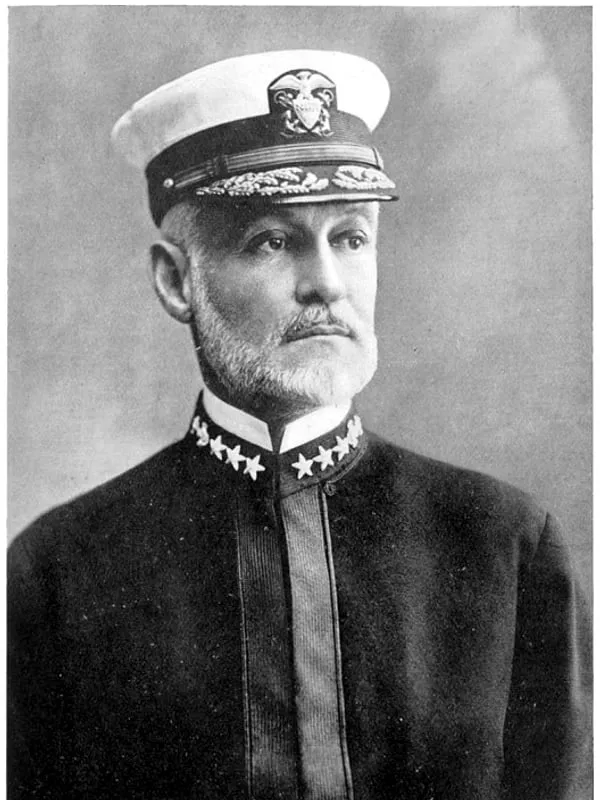
- Born:
- 15 October 1858, Port Hope (Ontario, Canada)
- Died:
- 28 September 1936, Boston
- Author:
- Łukasz Skowroń
- Photo:
- user:RJHall, domena publiczna, Wikimedia Commons

William Sowden Sims was the most important American admiral of the First World War, although he fought no battle in it. He arrived in London in April 1917, at a moment when German submarines were sinking ships faster than the Allies could build them, and from the first days he pressed Washington to send to Europe every vessel capable of fighting them. He supported the introduction of convoys and made the American destroyers part of the British system of shipping defence, placing them under British admirals. On the day of the armistice he commanded about 370 vessels and more than 80,000 men in several dozen bases from Ireland to Corfu. He was also an unruly man, openly Anglophile and perpetually at odds with his superiors, and after the war he accused his own department of having prolonged the war by its sluggishness.
Before the war
He was born on 15 October 1858 in Port Hope, Ontario, in Canada, the son of an American father and a Canadian mother. As a child he moved with his family to the United States. In 1880 he graduated from the Naval Academy at Annapolis. At the end of the 19th century he was naval attaché in Paris and St Petersburg, and during the Spanish–American War of 1898 he gathered intelligence in Europe on the Spanish fleet.
He made his name in the fight for accurate naval gunnery. In the war with Spain American ships had scored very few hits. In Chinese waters Sims met the British captain Percy Scott and his method of continuous-aim firing, in which the gun layer keeps correcting the gun’s aim the whole time, compensating for the ship’s roll. When his superiors ignored his reports, he wrote directly to President Theodore Roosevelt. In 1902 Roosevelt appointed him inspector of target practice for the fleet, and in 1907–1909 made him his naval aide. Within a few years the accuracy of the American fleet rose markedly. Sims also criticised battleship designs and called for ships with a uniform armament of big guns. In China in 1901 he also met Captain John Jellicoe, with whom he became friends.
In December 1910, when the American fleet was visiting England, Sims said at a reception in London’s Guildhall that if the British Empire were ever seriously threatened by a foreign enemy, it could count on every man, every dollar and every drop of blood of its “kindred across the sea”. Germany took this as the announcement of an alliance, and President William Taft publicly reprimanded him. In 1913–1915 Sims commanded the destroyer flotilla of the Atlantic Fleet and trained it in squadron operations that later proved invaluable. In 1916 he was the first commanding officer of the new battleship Nevada, and in February 1917, as a rear admiral, he took over as president of the Naval War College in Newport.
Mission in London
At the end of March 1917, while the United States was still formally neutral, Secretary of the Navy Josephus Daniels sent him secretly to London to arrange cooperation with the Royal Navy. According to Sims’s later testimony, the Chief of Naval Operations, Admiral William Benson, warned him before he left not to let the British “pull the wool over your eyes”, since it was a matter of indifference to America who pulled the chestnuts out of the fire for them. Sims sailed on a passenger liner under an assumed name, in civilian clothes. On 9 April he arrived in Liverpool, three days after the declaration of war on Germany.
In London Jellicoe, now First Sea Lord, showed him the secret loss figures. Since the declaration of unrestricted submarine warfare more than half a million tons of shipping had been sunk every month, and in April losses were approaching 900,000 tons. According to Sims’s memoirs, Jellicoe admitted that with such losses Britain could not go on with the war, and he saw no remedy. Sims bombarded Washington with cables demanding that every destroyer, gunboat, armed yacht and tug the fleet had be sent. He argued that the German submarines had to be defeated in the approaches to the British Isles, not by patrolling the American coast, and that America should for the time being put off building battleships in favour of escort vessels and merchant ships.
He was one of the most ardent advocates of convoys (PL), which the British admirals still regarded with reserve. At the end of April the Admiralty agreed to trial convoys, in May it set up a committee to organise them, and in June it approved the convoy system. Sims’s part in this decision is disputed. British historians attribute it above all to their own officers, to Prime Minister David Lloyd George and to their calculations, but they agree that the American destroyers made its introduction possible.
Queenstown and London
On 4 May the first six American destroyers arrived at Queenstown in Ireland, and by early July there were more than thirty there. Sims did something unprecedented in the history of the American navy: he placed them under the orders of the British Vice-Admiral Lewis Bayly, commander on the coast of Ireland. The gruff Bayly and the American admiral quickly became friends. When Bayly went on leave in June, Sims commanded for several days all the British and American ships in Irish waters from Queenstown. He was convinced that never before had a foreign admiral’s flag flown over a British base.
In May 1917 he was promoted to vice admiral, and his post was named the command of United States Naval Forces Operating in European Waters. For the first months his entire staff consisted of himself and an aide, in one room of the embassy. In time his headquarters, in several houses in Grosvenor Gardens, directed forces scattered across the whole of Europe: destroyers at Queenstown and Brest, which escorted the troop convoys for John Pershing, ships at Gibraltar, submarine chasers in the Mediterranean and in the Strait of Otranto, naval aviation, minelayers in the North Sea, and battleships. In December four American dreadnoughts joined the Grand Fleet as its 6th Battle Squadron. Sims also represented the United States on the Allied Naval Council, set up at the end of 1917. In the summer of 1918 he provisionally approved the signature of the commander of the American cruiser Olympia on the agreement on the defence of Murmansk.
Throughout this time he quarrelled with Washington. He believed that the Navy Department did not answer his cables, did not give him enough men and ships, and wanted to direct the naval war from across the ocean. Washington replied that Sims saw the war through the eyes of the Admiralty and forgot the interests of his own country, including the protection of the American coast and of troop transports. Daniels and Benson distrusted him above all because he accepted British honours and the British point of view too readily. Even so, on the day of the armistice the forces under his command numbered, according to his memoirs, about 370 vessels of all classes, more than 5,000 officers and more than 75,000 sailors in about 45 bases. In December 1918 he was promoted to temporary admiral.
After the war
In April 1919 Sims returned to Newport as a rear admiral and again took charge of the Naval War College. In protest at the way Daniels distributed decorations, he refused to accept the Distinguished Service Medal. In January 1920, in a letter to the Secretary of the Navy entitled “Certain Naval Lessons of the Great War”, he accused the department of having failed in the first months of the war to send ships to Europe in time and of having had no plans. He claimed that this had cost the Allies 2.5 million tons of shipping, prolonged the war by several months and cost hundreds of thousands of lives. The letter became the subject of Senate hearings, in which Daniels defended himself effectively, reproaching Sims for his Anglophilia and narrow London outlook. The book The Victory at Sea, written by Sims with the journalist Burton Hendrick, won the Pulitzer Prize for History in 1921. In 1921 in London he again caused a storm by criticising supporters of Irish independence in America, for which he received another reprimand. He retired in October 1922. In the 1920s he was an ardent supporter of the development of naval aviation and aircraft carriers. In 1930 he was given the rank of admiral on the retired list. He died on 28 September 1936 in Boston and was buried in Arlington National Cemetery.
Assessment
Naval historians agree in regarding Sims as one of the most outstanding American officers of his generation. They stress that he judged early and accurately where the war at sea would be decided, that he knew how to work with allies as few others did, and that his decision to place his ships under British command gave the common defence of shipping a single direction. His contribution to the history of the US Navy in fact reaches far beyond the war: gunnery accuracy, destroyer training and the development of the Naval War College are largely his achievement.
Critics, both contemporaries and some later historians, point to his one-sidedness. He was accused of accepting British arguments too readily and of exaggerating in his dispute with Daniels by putting the effects of the delays at hundreds of thousands of casualties. His biographer Elting Morison, his son-in-law, portrayed him as a reformer fighting bureaucracy, but even sympathetic authors admit that his hot temper and lack of diplomacy towards his superiors harmed him and perhaps cost him the highest posts. His friendship with Bayly and the cooperation at Queenstown nevertheless became a lasting symbol of the Anglo-American alliance at sea, to which both navies returned in the Second World War.
Sources
Spotted a mistake?Report an error
Often appears with
People who appear in the same events.