Poland · The Polish cause
Bolesław Roja
Commander of the 4th Legions Infantry Regiment (1915–1917) and of the Third Brigade (1917), from 1 November 1918 brigadier-general and military commandant in Kraków
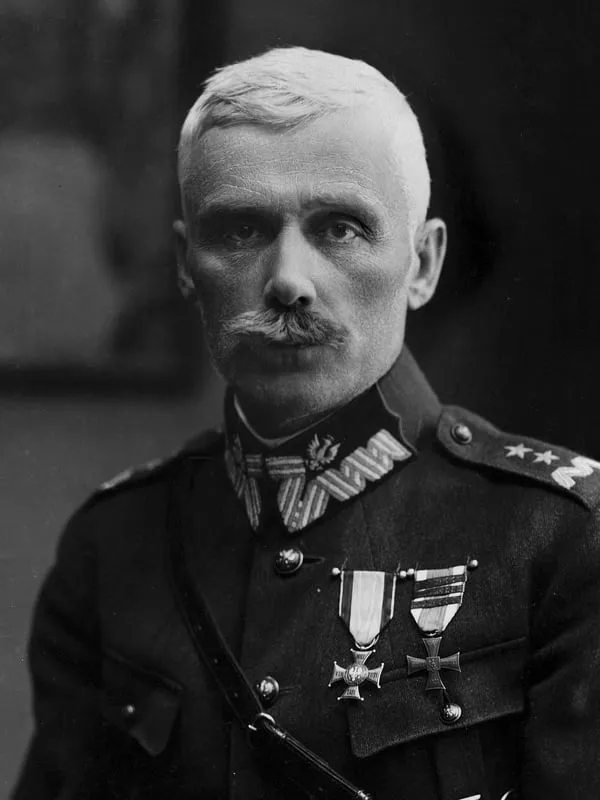
- Born:
- 4 April 1876, Bryńce Zagórne (Galicia, Austria-Hungary)
- Died:
- 27 May 1940, Sachsenhausen concentration camp
- Author:
- Natalia
- Photo:
- autor nieznany, domena publiczna, Wikimedia Commons

Bolesław Roja was one of the most colourful and most controversial commanders of the Legions. The son of a forester, an officer of peasant origin, rare among future generals, in 1915 he created the 4th Legions Infantry Regiment, the famous “Fourths”, and led it to the front. He was regarded as a commander daring to the point of recklessness, whose soldiers suffered heavy losses. In July 1917, by then commander of the Third Brigade, he sided in the oath crisis with those refusing the oath and was thrown out of the Legions. In the autumn of 1918 he was the leader of the Polish military conspiracy in Kraków, and on 31 October took over military authority in the city from the Austrians; in November he sent from Przemyśl the relief force that decided the outcome of the fighting for Lviv. After the war he became a fierce critic of Piłsudski, and in 1940 he was murdered in a German concentration camp.
Before the war
He was born on 4 April 1876 at Bryńce Zagórne in Bóbrka district, into the family of Józef, a farmer and forester, and Maria née Trzcińska. He attended gymnasiums in Lviv and Kraków and took his school-leaving examination at the St Anne Gymnasium in Kraków. From 1895 to 1898 he attended the cadet school at Wiener Neustadt, and from 1900 served as a second lieutenant in the 36th Landwehr Infantry Regiment at Kolomea. In 1905 he transferred to the reserve. According to the head of Austrian intelligence, Maximilian Ronge, from 1906 he worked for the Austrian intelligence services. As a civilian he studied law, and then medicine at the Jagiellonian University, but did not complete his studies. He worked in the Kraków municipal office and in the Polish Emigration Society.
The Legions
On the outbreak of war he joined the Kraków “Sokół” and trained the Sokół Field Squads. On 29 August 1914 he began service in the Polish Legions. In the 2nd Regiment he commanded a battalion, with which at the beginning of October he set out for Máramaros and fought in the Carpathians, in the ranks of the future Second Brigade. At Mołotków on 29 October his battalion suffered heavy losses and Roja was wounded in the arm. He blamed the defeat on the Legions Command and the Austrians. In November he was promoted to major. In the winter he defended Rafajłowa in the Gorgany together with the units of Józef Haller, and on the night of 23–24 January 1915 repulsed a Russian night attack on the village. One legionnaire wrote of him that he had “the swashbuckling soul of a raider” and “an unbridled temperament”.
In March 1915 Roja, by then a lieutenant-colonel, proposed forming a new regiment from battalions of the Second Brigade and volunteers from the Kingdom. From April to May the 4th Legions Infantry Regiment (PL) was formed at Rozprza near Piotrków, and Roja, who as a schoolboy had dreamed of commanding the legendary 4th Regiment of the November Uprising, became its commander. Most of the soldiers were of peasant origin, many came from Podhale, and the regiment was distinguished by tall square-topped caps known as “rojówki”. On 15 July the Fourths set out from Piotrków for the front.
The regiment’s baptism of fire at Jastków near Lublin, from 31 July to 3 August 1915, was bloody. Estimates of the losses vary: according to the writer Władysław Orkan, the regiment’s chronicler, they were about 50 killed and 270 wounded. Roja was accused of squandering his soldiers’ lives, and when the 4th Regiment was placed under Józef Piłsudski, the two had a sharp exchange. Piłsudski considered that Roja had attacked too recklessly, while Roja accused Piłsudski and the commander of the neighbouring 7th Regiment of sluggishness. Men deserted from the regiment to the First Brigade, and Roja himself explained years later that he had been ordered to attack fortified positions on the hills and “there had to be losses”. In September 1915 he was promoted to colonel.
In the autumn the regiment fought in Volhynia, on the Styr, and in February 1916 Roja was again wounded in the arm on a patrol in front of the Russian lines. Despite the dispute at Jastków he was regarded as a Piłsudskiite. He was one of the initiators of the Council of Colonels (PL), which from February 1916 brought together the commanders of the Legion regiments against the policy of the Legions Command, and its first meeting was held in his regiment’s camp. At the regimental feast in May 1916 he publicly declared himself a supporter of Piłsudski, for which his superior put him on report. In July the 4th Regiment fought in the Battle of Kostiuchnówka, the largest battle of the Legions. In August Roja signed, together with Piłsudski, Haller and Kazimierz Sosnkowski, a memorandum to the Supreme National Committee demanding that the Legions be recognised as the nucleus of a Polish army.
The oath crisis
On 18 June 1917 Roja took command of the Third Brigade. When in July the legionnaires were to swear loyalty and brotherhood in arms with the armies of Germany and Austria-Hungary, Roja stood before the 5th Regiment on 13 July and left the decision to the soldiers’ consciences. The whole regiment refused the oath, and the officers then carried the brigade commander shoulder-high to the officers’ mess. On 3 August 1917 Roja was dismissed from the Legions and, as an officer of the Austrian army reduced to the rank of second lieutenant, sent to Graz, to a Tyrolean rifle regiment. When in October the Regency Council took office, he called on Poles in the Austrian army to return “to the Polish ranks”. This met with criticism from legionnaires, who believed that their interned comrades had to be freed first. Thanks to the intercession of the deputy Herman Lieberman, in the spring of 1918 he left the Austrian army and returned to Kraków.
Kraków and Lviv, 1918
In Kraków Roja renewed his contacts with former Fourths and became the head of the Polish military conspiracy preparing to take power in the city. When on 28 October Polish deputies set up the Polish Liquidation Commission, he held back the order to rise, waiting for political decisions. Lieutenant Antoni Stawarz (PL) did not wait, and early on 31 October disarmed the Austrians in Podgórze. When the Polish units were already in the Main Square, before noon Roja came out of the room where talks were being held with the Austrian commandant, General Siegmund von Benigni, and announced that the Austrian command had surrendered. On 1 November, by order of the Liquidation Commission, he formally took over the Military Command in Kraków, and the Regency Council appointed him a brigadier-general that day. The liberation of Kraków took place without a single shot. Princess Maria Lubomirska then wrote in her diary that Roja was “a Piłsudskiite, brutal, bold, a brave condottiere”, but also a man who rushes “into independent action, rather than persevering in disciplined duty”.
Meanwhile in Lviv the Poles had been defending themselves against the Ukrainians since 1 November. A detachment under Major Julian Stachiewicz set out by train from Kraków and on 11–12 November drove the Ukrainians out of Przemyśl. Roja organised a relief group there and entrusted it to Lieutenant-Colonel Michał Tokarzewski-Karaszewicz. According to Michał Klimecki it numbered 140 officers, 1,228 soldiers and 8 guns. On 20 November it reached Lviv, and on 22 November the Ukrainians left the city. Roja appointed the previous commandant of the defence, Czesław Mączyński, commandant of the city. When on the day of victory a pogrom broke out in the Jewish districts, Roja ordered a state of emergency and summary courts on 22 November, but the order was announced only on 24 November. A few days later General Tadeusz Rozwadowski took over command in Lviv.
After the war
In 1919 he commanded the 2nd Legions Infantry Division and a group on the Lithuanian-Belarusian Front which took Minsk on 8 August. He then commanded the general districts of Kielce and Pomerania. In August 1920, during the Bolshevik offensive, he briefly commanded an operational group on the Narew, and then the 2nd Army. He criticised the General Staff and doubted victory, and at the beginning of August he reportedly proposed to Wincenty Witos the removal of Piłsudski and a people’s government headed by Witos. Witos refused and informed the general’s superiors. Still in August Roja was relieved of his command, and in 1922 he was retired as a war invalid. He drew close to the peasant movement and in 1928–1929 was a deputy for the Peasant Party. He sharply criticised the Sanation regime, and in 1937, when he tried to speak at a legionnaires’ rally in Kraków, he was confined in the psychiatric ward of a military hospital. In March 1940 the Germans arrested him. From Pawiak prison he was sent to the Sachsenhausen concentration camp, where on 27 May 1940 an SS man murdered him in front of a barrack.
Assessment
Roja has not yet received a full scholarly biography. Contemporaries and historians stress his personal courage and his talent as an organiser who built one of the best regiments of the Legions out of Carpathian battalions and volunteers. At the same time his severity, recklessness and the losses at Jastków followed him for years. Aleksandra Kozłowska, author of a study of his Legion career, sees him as a man of uncompromising views who repeatedly set an example of military and civic courage. The same independence, which Princess Lubomirska called a tendency to “independent action”, got him into trouble in turn with the Austrians, with Piłsudski and with the Sanation authorities. His memory has survived in the tradition of the Fourths, in Kraków, where a plaque on the Town Hall Tower recalls the events of 31 October 1918, and in Legionowo, which he named in 1919.
Sources
Spotted a mistake?Report an error
Commanded in battles
(01)Mentioned in battles
(02)On the timeline
(03)1918
October
November
- 22
- Poles take LvivOn the night of 21–22 November 1918 the Ukrainians withdrew from Lviv, and in the morning the Poles took the city. On the day of victory a pogrom broke out.
- Pogrom in LvivOn 22–24 November 1918, after the Poles took Lviv, soldiers and civilians looted and burned the Jewish quarter. Between several dozen and 150 Jews were killed.