Poland · The Polish cause
Antoni Ponikowski
Minister of Religious Denominations and Public Enlightenment of the Kingdom of Poland (December 1917 – November 1918), chairman of the provisional government (27 February – 4 April 1918)
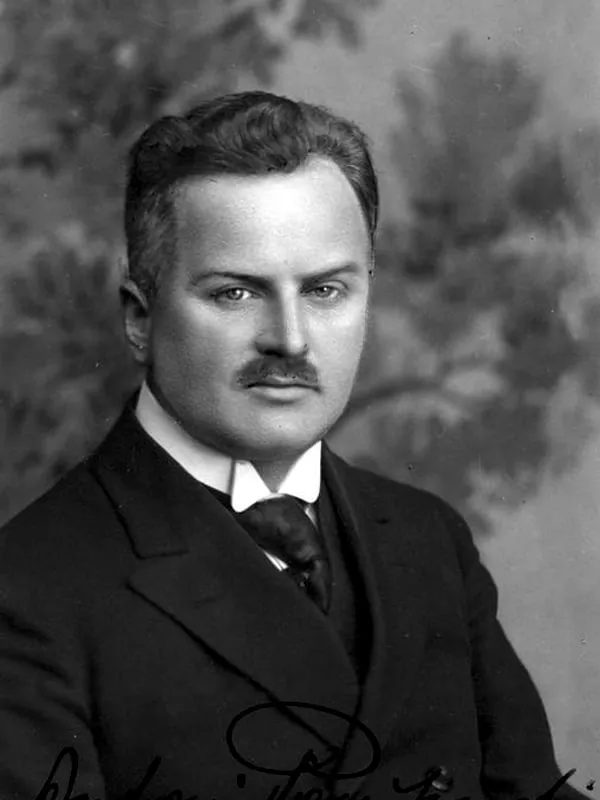
- Born:
- 29 May 1878, Siedlce (Kingdom of Poland, Russian Empire)
- Died:
- 27 December 1949, Warsaw
- Author:
- Natalia
- Photo:
- Masłowski A, domena publiczna, Wikimedia Commons

Antoni Ponikowski was an engineer specialising in land reclamation and surveying, a professor at the Warsaw Polytechnic and one of the most persevering officials of the state built in the Kingdom of Poland under the occupation of the Central Powers. From December 1917 to November 1918 he headed the department of religious denominations and public enlightenment in all the successive cabinets appointed by the Regency Council. When in February 1918 the government of Jan Kucharzewski resigned in protest against the Treaty of Brest-Litovsk with Ukraine, he led a provisional government for five weeks. Under his direction the foundations were laid of the Polish school administration that the reborn state took over in November 1918. In independent Poland he was twice prime minister and rector of the Warsaw Polytechnic.
Before the war
He was born on 29 May 1878 in Siedlce, the son of Stanisław, an official of the Credit Society. He finished the Siedlce gymnasium with a gold medal and began studying mathematics at Warsaw University, and after the Warsaw Polytechnic Institute (PL) opened in 1898 he transferred to its civil engineering faculty, graduating with distinction in 1903. He worked on surveys of the Vistula between Warsaw and Modlin, then in the land reclamation office of the Galician Provincial Department in Kraków, and from 1907 ran his own land reclamation office in Warsaw. He taught surveying and land reclamation on courses at the Museum of Industry and Agriculture. He was also a keen singer and a co-founder of the Warsaw choir “Pieśń”.
He became involved in politics while still a student. He was a co-founder and for a year president of the Union of Students of the Polytechnic, and belonged to the secret National League. The biography published by the Warsaw Polytechnic states that in June 1911 he left the League in protest against the pro-Russian policy of Roman Dmowski and founded the so-called Secession, transformed in 1914 into the National Union and then into the Polish National Union. He thus belonged to the part of the national camp that had broken with the line of cooperation with Russia even before the war.
During the war
After the Germans took Warsaw in August 1915, Ponikowski and part of his group joined the League of Polish Statehood (PL), which gathered activists (PL), that is, supporters of building a Polish state alongside the Central Powers. He devoted himself above all to education. The occupiers agreed to the opening of a Polish university and of the Warsaw Polytechnic in November 1915, and Ponikowski took part in organising the latter. From 1916 he headed its chair of surveying, and in 1917 he was dean of the faculty of agricultural engineering. At the same time he was secretary of the board and head of the office of the education department of the Citizens’ Committee of the City of Warsaw (PL), which ran the Polish schools in the city. From 1916 he sat on the Central Welfare Council (PL), and as a Warsaw city councillor he sharply criticised the municipal school department and called for teacher-training colleges to be founded and for the cost of schooling in elementary schools to be lowered. In 1917 he worked on committees of the agriculture and labour departments of the Provisional Council of State.
When the Regency Council took power and Kucharzewski was assembling the first government of the Kingdom of Poland, Ponikowski received the portfolio of religious denominations and public enlightenment. Biographies give the date of his appointment as 7 December 1917, the day the regents approved the list of ministers. Education was one of the two fields in which the Poles already had real power: in the German Government-General of Warsaw it had been handed over to Polish hands on 1 October 1917, in the Austro-Hungarian occupation zone on 1 November. From 1 February 1918 the former department of the Provisional Council of State was transformed into a ministry, which covered schools of all levels, science, archives, libraries, museums and religious affairs.
After the conclusion of the Peace of Brest-Litovsk with Ukraine, which gave the Chełm Land to Ukraine, Kucharzewski and his ministers resigned. The regents accepted the resignation on 27 February 1918 and on the same day appointed a provisional government (PL), formally the Council of Heads of Ministries, with Ponikowski at its head. The Warsaw Polytechnic biography gives the date as 17 February. The provisional government consisted mainly of undersecretaries of state who conducted the current business of the ministries. Its main task was to maintain the continuity of the administration until the regents found a new prime minister. It ended on 4 April 1918, when the Regency Council appointed the government of Jan Kanty Steczkowski.
In Steczkowski’s cabinet Ponikowski was again minister of education, alongside Jan Stecki in internal affairs. He also kept his portfolio in the government of Józef Świeżyński, appointed on 23 October 1918, after the regents’ proclamation of 7 October had announced an independent and united Poland. The Regency Council dismissed this cabinet on 4 November, after its unauthorised call for the formation of a national government, and with that Ponikowski’s work in the governments of the Kingdom came to an end. The ministry he had built passed into the administration of the reborn state.
After the war
In 1919 Ponikowski became a full professor at the Polytechnic, and in 1920 he was active in the Citizens’ Executive Committee for the Defence of the State. The university senate elected him rector for 1921/1922, but in September 1921 the Chief of State appointed him prime minister. His two successive cabinets, regarded as non-party and expert, governed from 19 September 1921 to 6 June 1922 and were meant above all to put the economy in order, which they failed to do. The second fell after a conflict with Józef Piłsudski. Ponikowski returned to the university, was rector again in 1923/1924, and later pro-rector and dean. He became associated with Christian Democracy and was a deputy in 1930–1935; in 1935 he led a breakaway, pro-Sanation group of Christian Democrats and soon withdrew from politics. He chaired the committee for building the Chopin monument in the Łazienki Park and for many years presided over the Museum of Industry and Agriculture. During the German occupation he taught in clandestine classes and worked on plans for rebuilding higher education, and, wanted by the Gestapo, had to go into hiding. In 1945 he served as acting rector of the Polytechnic, temporarily based in Lublin. He died in Warsaw on 27 December 1949.
Assessment
Ponikowski was not a political leader. He was an expert and a public-spirited man who took on public service even under occupation. He belonged to those activists who did not count on great concessions from Berlin but wanted to use every space the occupiers left in order to build Polish institutions. In his case this meant above all education. Opponents of activism, especially the passivists (PL), accused the regents’ ministers of putting their names to the occupiers’ policy and of holding only illusory power. The continuity of the ministry that Ponikowski ran throughout the period of the Regency Council’s governments, and his later career as prime minister and rector, show, however, that some of the people of this circle entered the elite of the reborn state.
Sources
Spotted a mistake?Report an error
Often appears with
People who appear in the same events.