Poland · The Polish cause
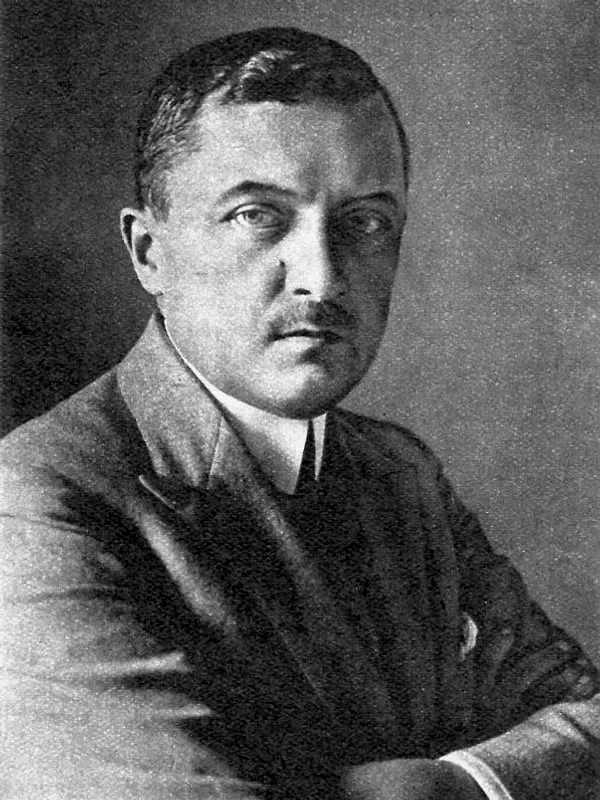
Marian Seyda
Co-founder of the Central Polish Agency in Lausanne (1915–1917), member of the Polish National Committee in Paris and head of its press department (1917–1919)
- Born:
- 7 July 1879, Poznań (Province of Posen, Prussia)
- Died:
- 17 May 1967, Buenos Aires
- Author:
- Natalia
- Photo:
- autor nieznany, domena publiczna, Wikimedia Commons

Marian Seyda was one of the people who made the voice of the Poles of the Prussian partition heard in the Entente camp. A Poznań journalist and activist of the secret National League, before the war editor of the “Kurier Poznański (PL)”, he left for Switzerland at the end of 1915 on the instructions of the Greater Poland National Democrats. In Lausanne he co-founded a Polish press bureau that showered the press of the Allied countries with information about the Polish cause, and in August 1917 he joined Roman Dmowski’s Polish National Committee. In Paris he ran its press department, travelled on missions to Rome and the United States, and at the peace conference he was an expert on the lands of the Prussian partition. He also wrote one of the basic accounts of Polish politics in the years of the Great War.
Before the war
He was born on 7 July 1879 in Poznań. At the St Mary Magdalene gymnasium he belonged to secret self-education circles linked to the Union of Polish Youth “Zet”, and in mid-1900 he was admitted to the National League. He studied law in Berlin and Breslau, where he took his doctorate, and then art history in Berlin and Munich. While still a student he wrote for the “Dziennik Berliński”, and in 1901 he published the pamphlet “Jeden naród – jedna myśl” (“One nation – one thought”), which promoted the programme of National Democracy in the Prussian partition. In Breslau he worked in “Zet” with Wojciech Korfanty.
In Poznań he quickly became one of the chief organisers of the national movement. He helped create the Polish Trade Union, which defended Polish workers and craftsmen, and in 1903 he co-wrote the programme of the National Democratic Party in the Prussian partition. The National League made him its commissioner for that part of Poland. In 1906 he co-founded the company Nowa Drukarnia Polska and became editor-in-chief of the “Kurier Poznański” and the “Orędownik”, which became unofficial organs of the League. In 1907 he joined its highest bodies, and in 1908 he represented Poznań at the Slavic congress in Prague. He also knew Polish politics in the Reich at close quarters through his family: his brother Zygmunt Seyda (PL) sat in the Reichstag and the Prussian Landtag.
Lausanne, 1915–1917
The outbreak of war put the Greater Poland National Democrats in a difficult position. Their sympathies lay with the Entente, but as German subjects they could not express them openly. They therefore decided to send their people to neutral Switzerland. According to the Polish Biographical Dictionary, Seyda went there at the end of 1915 together with Antoni Ludwiczak. After a short stay in Château-d’Œx he settled in Lausanne, where with Erazm Piltz (PL) and Aleksander Skarbek he founded the Central Polish Agency (PL). He was its secretary general and later its political director. The agency supplied the Western press with information and articles about the Polish lands, and it was also a base for Dmowski, who from the end of 1915 was working in London and Paris.
From May 1916 to August 1917 Seyda edited the fortnightly “Przegląd Polski” in Lausanne, and from 1916 he sat on the committee that published, in Fribourg and Lausanne, the multi-volume French-language “Encyclopédie Polonaise”, meant to bring knowledge of Poland to the West. After the Act of 5 November 1916 he was one of the twenty signatories of a protest against the emperors’ manifesto, published on 11 November. Its authors saw in the act the promise of a state cut down to part of the lands of the Russian partition and dependent on Germany. The Prussian authorities paid him back in kind: in 1917 a court sentenced him in absentia to a year in prison for failing to report for military service, and Seyda was struck off the list of Prussian citizens.
The Polish National Committee
On 15 August 1917 in Lausanne Dmowski founded the Polish National Committee. Seyda joined it as the representative of the Prussian partition and, together with Dmowski, Maurycy Zamoyski, Piltz and Jan Emanuel Rozwadowski (PL), belonged to the inner leadership based in Paris. The Lausanne agency became the Committee’s press organ, and Seyda took over its press department. He also represented the Committee in the office that dealt in France with the civil affairs of Poles, most of whom were formally subjects of the Central Powers.
From Paris he followed events at home closely. In the autumn of 1917 he prepared a long report on reactions to the patent on the Regency Council, which reached the United States ambassador in Paris. In it he wrote that the impression made by the acts of 12 September was “very weak”, and that society answered the occupiers briefly: “after the words, let deeds follow”.
At the beginning of 1918 Seyda held talks with representatives of the Czechs, the Yugoslavs and the Romanians. In April he was in the Polish delegation to the congress of oppressed nationalities in Rome, where the Committee presented the Polish cause as part of the programme of breaking up the Habsburg monarchy. From June to August 1918 he was in the United States on a mission for the Committee. There he talked with Ignacy Jan Paderewski and with activists of the National Department in Chicago, which had placed itself under the Committee’s authority. The aim was the support of the American Polish community for the Committee and volunteers for the Polish Army in France. Later the Committee sent him on a similar mission to Rome.
After the armistice Seyda went to Warsaw. According to his biographer, between 5 and 10 December 1918 he talked several times with Józef Piłsudski, presenting to him the national camp’s criticism of the Moraczewski government. The dispute between the Committee and the Chief of State over who was to represent Poland was settled only in January 1919, when Paderewski became prime minister.
The peace conference
In 1919 Seyda was a political expert of the Polish delegation to the Paris Peace Conference and a member of its commission on the Prussian partition. He wrote memoranda on Polish claims to Greater Poland, Pomerania and Silesia, and in Paris he published the book “Territoires polonais sous la domination prussienne”, in which he argued Poland’s rights to those lands. On 1 June 1919 he was elected in Greater Poland to the Legislative Sejm on the list of the Popular National Union. On 28 June he attended the signing of the Treaty of Versailles as a representative of the Polish press. He returned home for good in the autumn of 1919.
After the war
In the Legislative Sejm and the Sejm of the first term Seyda was deputy chairman of the foreign affairs committee. After the conclusion of the Lanckorona Pact he became foreign minister in 1923 in the government of Wincenty Witos. He held the office from May to October. After the May Coup he returned to journalism and from 1926 again edited the “Kurier Poznański”, and in 1928–1935 he was a senator. In 1936, disagreeing with the “young” in the National Party, he withdrew from its leadership. During the Second World War he was a minister in the government of Władysław Sikorski, from 1940 minister of justice. After the war he remained in exile, from 1948 in Argentina. He died on 17 May 1967 in Buenos Aires. In 1994 his remains were moved to the Cemetery of Distinguished Greater Poland Citizens in Poznań.
Assessment
Seyda was not a leader of the first rank, but he belonged to those collaborators of Dmowski on whom the day-to-day work of the national camp in the West rested. The Lausanne agency that he co-founded helped ensure that in the press of the Allied countries the Polish question ceased to be treated as an internal affair of Russia. In the Polish National Committee he represented the part of Poland whose fate depended on Germany’s defeat, and he made sure that the Polish programme included Greater Poland, Pomerania and Silesia. Kazimierz Marian Morawski called him in his memoirs “a hard, unyielding Poznanian”.
His writing also matters to historians. His two-volume work “Polska na przełomie dziejów” (“Poland at the turning point of history”), published in 1927–1931, is one of the main sources for the history of the Polish question during the Great War, though it was written from the perspective of the national camp and at a time of sharp dispute with the Piłsudskiites over credit for the recovery of independence.
Sources
Spotted a mistake?Report an error