United Kingdom · The Entente
Hugh Trenchard
Commander of the Royal Flying Corps in France (1915–1918), Chief of the Air Staff (1918, 1919–1929), commander of the Independent Force (1918)
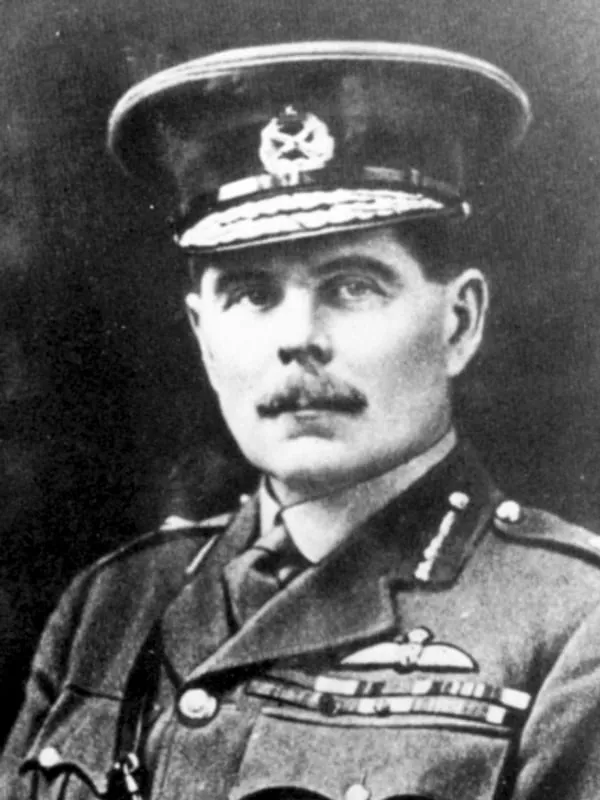
- Born:
- 3 February 1873, Taunton (Somerset)
- Died:
- 10 February 1956, London
- Author:
- Natalia
- Photo:
- autor nieznany, domena publiczna, Wikimedia Commons

Hugh Trenchard commanded British aviation on the Western Front for most of the war, from August 1915 to January 1918. An advocate of relentless offensive in the air, he demanded that the airmen of the Royal Flying Corps fight over the German side of the front, even at the cost of heavy losses. At the beginning of 1918 he became the first Chief of the Air Staff of the new air service, but left after a few weeks in a dispute with the minister. In the summer he commanded the Independent Force, which bombed the industry of western Germany. After the war, as Chief of the Air Staff, he defended the independence of the Royal Air Force for ten years and went down in history as the “Father of the RAF”, although he himself disliked the nickname.
Before the war
He was born on 3 February 1873 in Taunton (PL) in Somerset, into the family of a former officer who was working as an articled clerk in a law firm. He was a poor student. He failed the entrance examination for the navy, and he got into the army with difficulty, barely meeting the minimum requirements. At the end of 1893, as a young officer of the Royal Scots Fusiliers, he was posted to India, where he devoted more time to polo than to duty.
During the Second Boer War he volunteered for South Africa. He raised a unit of mounted infantry and on 9 October 1900, pursuing the Boers, he was ambushed at the Dwarsvlei farm. Shot in the chest, he lost a lung and was partly paralysed. He was sent to Switzerland to recover. There, out of boredom, he took up bobsleighing, and after a heavy crash on the run at St Moritz, as he himself told it, he regained the use of his legs. He returned to the front before the end of the war.
In 1903–1910 he served in Nigeria with the Southern Nigeria Regiment, which he commanded for several years. He led expeditions into the interior, to the lands later called Biafra, and for this service received the DSO in 1906. After his return, posted to a garrison in Ireland with the rank of major, he was bored and looking for a new occupation. At the urging of a friend, who had just been killed in a flying accident, in July 1912, at the age of 39, he enrolled at Thomas Sopwith’s flying school at the Brooklands (PL) track. After two weeks of instruction and 64 minutes in the air, on 31 July he gained pilot’s certificate No. 270. He concealed the fact that he saw poorly in one eye. Taken on by the Central Flying School at Upavon, he proved a mediocre airman but an able organiser. It was there that he acquired the nickname “Boom”, from his loud, booming voice. In September 1913 he became the school’s assistant commandant.
Royal Flying Corps, 1914–1915
When war broke out Trenchard, to his disappointment, stayed at home. When the RFC squadrons flew to France, he took over the Military Wing at Farnborough, that is the whole rest of the corps in England, and began creating new squadrons and schools. The target he initially set himself of 12 squadrons was later raised by Horatio Kitchener to 60. At the beginning of October, at Kitchener’s demand, he sent No. 6 Squadron to Belgium within 36 hours.
In November 1914 he took over No. 1 Wing of the RFC in France, which supported the troops of General Douglas Haig, from December commander of the First Army. So began a partnership that lasted the whole war. Haig let Trenchard into the plans for the spring attack, and aerial photographs of the trenches helped to rework the plan of the Battle of Neuve Chapelle. There the airmen carried out photographic reconnaissance on a large scale for the first time and bombed the enemy’s rear, though with modest effect. In August 1915, when David Henderson returned to the War Office, Trenchard, as a brigadier-general, took command of the whole Royal Flying Corps in France.
Commander of the RFC in France, 1915–1917
In the autumn of 1915 the Germans won superiority in the air, armed with Fokker monoplanes with a machine gun firing through the propeller. Trenchard answered with a principle he held to the end: aviation must attack. He believed that an aircraft over the trenches also affected the morale of soldiers, his own and the enemy’s, and that air superiority could only be won by fighting over the German side of the front. In the spring of 1916, as the corps grew rapidly, he was given the temporary rank of major-general, and in January 1917 this rank was confirmed.
From December 1915 Haig was commander-in-chief of the British Expeditionary Force, and Trenchard his closest adviser on aviation. In the Battle of the Somme in 1916 the RFC airmen followed the progress of the infantry, directed artillery fire, and on 15 September, in line with his doctrine, bombed the German rear on the day of the first tank attack. The price of this policy was high. In “Bloody April” 1917 over Arras the Germans shot down more than 240 British aircraft, and there was a shortage of pilots, whose training in England had been cut to the minimum. Trenchard did not change his principles, however: he held that the airmen had carried out their tasks, and the artillery had received its photographs and reports.
Strategic bombing of Germany was not alien to him, but he considered it secondary to the needs of the front. In the summer of 1917, after the daylight Gotha raids on London, he and Haig opposed sending fighter squadrons back to defend England. He was also long opposed to merging the army and naval air services, fearing that it would weaken support for the troops in France. When in the autumn he realised that a separate air force would be created anyway, he wanted to keep command of the aviation at the front, but without success. In October 1917, however, he formed No. 41 Wing near Nancy for attacks on the industry of western Germany.
Chief of the Air Staff, 1918
After the passing of the Air Force Act in November 1917, Trenchard was the natural candidate for Chief of the Air Staff of the new air service. On 16 December he was summoned to London for a meeting with Lord Rothermere, designated as Air Minister. When he heard that his support would be useful in a press campaign against Haig and the Chief of the Imperial General Staff, William Robertson, he refused. Rothermere and his brother, Lord Northcliffe, spent a dozen or so hours persuading him, threatening to turn his refusal against Haig. In the end he accepted the post, but only after speaking to Haig.
In the New Year Honours of 1918 he was knighted. The Air Ministry began work on 3 January, and Trenchard took up his duties on 18 January, after handing over command in France to General John Salmond. He quarrelled with Rothermere over almost everything: over the role of advisers from outside the services, over appointments and over the future use of air power. When in mid-March he learned that the minister had promised the navy 4,000 aircraft for anti-submarine work, although there were fewer than 400 to spare in the country, he resigned on 19 March. He agreed only to postpone its announcement until the creation of the RAF on 1 April. Meanwhile, on 21 March, the German offensive on the Somme began, and Trenchard ordered all reserves of aircraft, engines and men to be sent to France. On 13 April General Frederick Sykes succeeded him, and less than two weeks later Rothermere also went.
The Independent Force
For several weeks Trenchard was without a post. The new minister, William Weir, offered him various positions, which Trenchard rejected as titular. According to his biographers the turning point came on 8 May, when on a bench in Green Park he overheard a naval officer saying that he would have shot a man who threw in his hand in the middle of a battle. That day he wrote to Weir that he would accept command of the bombers in France.
On 5 June 1918 he took command of VIII Brigade RAF in Lorraine, from which the Independent Force was formed the next day, and on 15 June he assumed full authority over it. With his headquarters at Nancy, he was subordinate neither to Haig nor to Ferdinand Foch, but directly to the Air Ministry. His deputy was Cyril Newall, who had previously led raids from these airfields, among others on Cologne. He concluded that he could not destroy individual industrial centres, so he attacked as many towns as possible so that none would feel safe. In a report of early 1919 he wrote that the moral effect of bombing stood to the material effect as 20 to 1.
The French regarded the Independent Force with suspicion, and Foch at first refused to recognise it. The disputes over supplies were resolved only by a conversation between Trenchard and General Noël de Castelnau. In September Trenchard’s bombers attacked airfields, depots and railway lines behind the front at Saint-Mihiel, indirectly supporting the Americans, and at the end of October the formation became the Inter-Allied Independent Air Force under Foch’s authority. By the armistice, according to the British official history, it had dropped 543 tons of bombs.
After the war
In January 1919 Trenchard put down a mutiny of about five thousand soldiers in the port of Southampton who did not want to return to France now that the war was over. This impressed Winston Churchill, the new Secretary of State for War and Air, who at the beginning of 1919 restored him to the post of Chief of the Air Staff. Trenchard held it until the end of 1929. He defended the RAF against the army and the navy, which wanted their air arms back, founded the officers’ college at Cranwell, a system of training aircraft apprentices and the staff college at Andover, and in Iraq and on other frontiers of the empire introduced so-called air control. In 1927 he became the first Marshal of the RAF. In 1931–1935 he was Commissioner of the London Metropolitan Police and founded the police college at Hendon. In 1930 he was made a baron, and in 1936 a viscount. His elder son was killed in 1943 in North Africa. He died in London on 10 February 1956, and his ashes were laid in the RAF Chapel in Westminster Abbey.
Assessment
Trenchard was neither an outstanding pilot nor a theorist, but an organiser and commander who could win over his subordinates. Unlike many generals of this war, he regularly visited airfields and squadrons and listened to the men from the front line. Few of the RFC airmen failed to admire him, though some, as the RAF history site Air of Authority notes, did so “grudgingly”. Critics accuse him of letting the stubborn offensive in the air cost the lives of hundreds of young, poorly trained pilots. His defenders point out that thanks to it the army received photographs, reconnaissance and artillery support, which was what it needed most.
After the war he became one of the first advocates of strategic bombing, alongside the Italian Giulio Douhet (PL). His conviction that a war could be won by breaking the enemy’s industry and morale from the air shaped British bomber aviation in the Second World War. He disliked the nickname “Father of the RAF”: he believed it belonged rather to General David Henderson, the first commander of the Royal Flying Corps. Yet without his persistence in the 1920s an independent British air force might not have survived.
Sources
Spotted a mistake?Report an error