Poland · The Polish cause
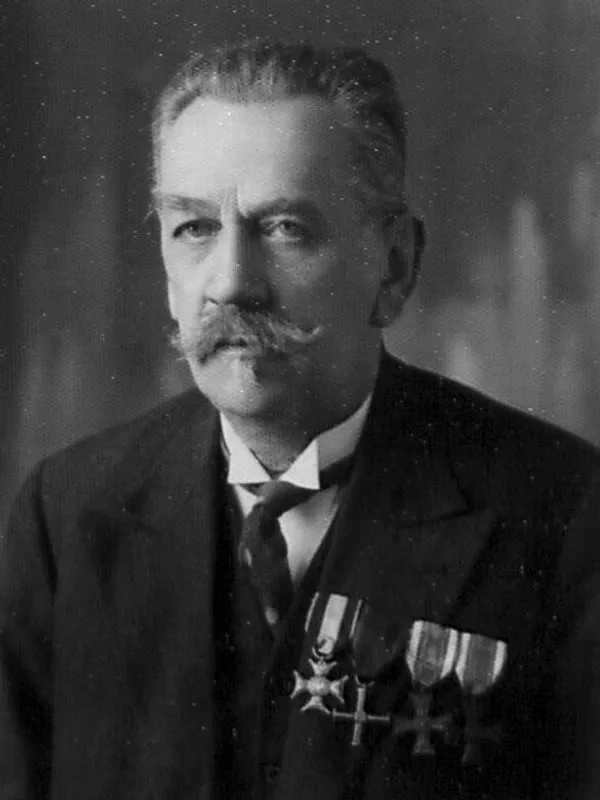
Jędrzej Moraczewski
Deputy to the Imperial Council in Vienna (1907–1918), minister of communications in the Lublin government, prime minister (17 November 1918 – 16 January 1919)
- Born:
- 13 January 1870, Trzemeszno (Province of Posen, Prussia)
- Died:
- 5 August 1944, Sulejówek
- Author:
- Natalia
- Photo:
- autor nieznany, domena publiczna, Wikimedia Commons

Jędrzej Moraczewski was a railway engineer, a Galician socialist and a deputy to the Austrian parliament who during the war followed Piłsudski into the Legions. He went down in history as the first prime minister of the government of reborn Poland. On the night of 17–18 November 1918 Józef Piłsudski entrusted him with a cabinet which in less than two months introduced the eight-hour working day, social insurance and an electoral law that gave women the vote. It was, at the same time, a weak government. The right considered it revolutionary, the far left bourgeois, and the Entente powers would not recognise it. In January 1919 it survived a failed coup, and a dozen or so days later it made way for the cabinet of Ignacy Jan Paderewski.
Before the war
He was born on 13 January 1870 in Trzemeszno in the Prussian partition, into the family of the architect and builder Maciej Moraczewski. His mother died soon after his birth. The family moved often until it settled in Lviv, where Jędrzej passed his school-leaving examination and studied at the Lwów Polytechnic. As a student he was active in the Bratnia Pomoc self-help society and in an illegal self-education circle. At first hostile to socialism, he came in time to believe that independence had to be fought for together with the most numerous strata of the nation, the peasants and the workers. In 1893 or 1894, as the biographies variously state, he joined the Galician social democratic party, later the Polish Social Democratic Party of Galicia and Cieszyn Silesia. In 1896 he married Zofia Gostkowska, the daughter of the rector of the Polytechnic and herself a socialist activist.
For more than ten years he worked as an engineer. He built railway lines in Galicia, among them from Sambor to Sianki and from Lviv to Podhajce, and also in Dalmatia. He supported the party with money, and Józef Piłsudski used his passport in 1904 on his journey to Japan. In 1907, persuaded by the party leadership, he gave up his professional career and won a seat in the Imperial Council in Vienna for the Stryj–Kałusz constituency. He dealt with social legislation and the working conditions of railwaymen and salt miners, and founded trade unions and cooperatives. In 1911 he was re-elected, and he held his seat as an Austrian deputy until the end of October 1918. He wrote campaign pamphlets under the pen name Edward Pomorski.
In the Legions
In August 1914 Moraczewski was among those Galician socialists who, together with Ignacy Daszyński, backed Austria-Hungary against Russia. He organised collections for the riflemen and joined the Polish Legions. He served in the First Brigade, with which he fought among other places in Volhynia on the Styr and the Stokhid, and on 29 October 1914 he was made a lieutenant. Piłsudski, however, also assigned him to political work. Moraczewski sat on the Supreme National Committee, which directed the affairs of the Legions from Kraków, and wrote pamphlets for the soldiers, including “Zarys sprawy polskiej w obecnej wojnie” (“An outline of the Polish question in the present war”), infantry drill regulations and translations of German engineering manuals. In the spring of 1917 he served in the Legions Command.
Unlike many of Piłsudski’s followers who came from socialism, he did not abandon his social programme. He argued that independence would be won not only by an army but also by the support of the broad masses, and he travelled to meetings with workers and peasants to win them over to the Legions. In May 1917 the Germans arrested him in Warsaw for taking part in a secret meeting of legionaries. He was released because as a deputy he had to attend the session of the Vienna parliament that had just been convened.
After the oath crisis and Piłsudski’s arrest in July 1917 Moraczewski was among the men who took over the leadership of his camp. Together with Bogusław Miedziński (PL) and Tadeusz Kasprzycki he co-founded the Convent of Organisation A (PL), the secret leadership of the Piłsudskiites, and served as political head of the Polish Military Organisation. On his initiative the Polish Circle in Vienna passed a motion on 6 August 1917 calling for the release of the legionaries interned at Szczypiorno (PL).
The Lublin government and the premiership
In the autumn of 1918 the Habsburg monarchy was falling apart. At the end of October Moraczewski became involved with the Polish Liquidation Commission, which took over power in Galicia after the liberation of Kraków. At the beginning of November he joined Daszyński’s Lublin government as minister of communications. On the orders of Colonel Edward Rydz-Śmigły he went to Galicia to win over the Polish command there for the government, but General Bolesław Roja agreed to subordinate himself only to Piłsudski, once he returned from internment. Moraczewski later described the joy of those days in words that became part of the canon of memories of 11 November: “After 120 years the cordons burst. ‘They’ are gone. Freedom! Independence! Unification! A state of our own!”
Piłsudski, who returned to Warsaw on 10 November, first entrusted the task of forming a government to Daszyński. When the National Democrats refused to take part in a cabinet headed by a socialist, Daszyński withdrew and proposed Moraczewski in his place, a socialist but a moderate politician close to Piłsudski. On the night of 17–18 November Piłsudski appointed him prime minister, and the ministers took over their departments on 18 November. Moraczewski’s government was largely a continuation of the Lublin one: internal affairs went to the peasant politician Stanisław Thugutt, foreign affairs to the socialist Leon Wasilewski. Daszyński later claimed in his memoirs that it was he who had assembled this cabinet. According to accounts, Piłsudski set the new prime minister two conditions: not to change social relations by decree, and to prepare an electoral law within a week.
The cabinet acted quickly. Within a few days it introduced the eight-hour working day, and in the following weeks decrees on sickness insurance, labour inspection, labour exchanges, protection of tenants and the fight against profiteering. On 28 November it issued the electoral law for the Legislative Sejm, with universal suffrage for women and men. The government also negotiated with the German envoy Harry Kessler the withdrawal of troops from Ober Ost through East Prussia, bypassing Polish territory, and on 15 December it broke off relations with Germany. Moraczewski recalled that the agreement with Kessler had been very advantageous for Poland.
The government’s weaknesses, however, were serious. Landowners and supporters of the National Democrats saw in it a harbinger of revolution and in places refused to pay taxes. The communists, who in December founded a party opposed to an independent state, called it bourgeois. The Paris Polish National Committee of Roman Dmowski did not recognise it, and the Entente looked with distrust on a cabinet of men who had fought during the war on the side of the Central Powers. On the night of 4–5 January 1919 conspirators from National Democratic and landowning circles, led by Colonel Marian Januszajtis and Prince Eustachy Sapieha, made an attempted coup. They arrested Moraczewski and the ministers Thugutt and Wasilewski, but troops loyal to the government quickly disarmed the conspirators and freed the detainees. Piłsudski nevertheless concluded that the country needed a government that would reconcile it with the right and win the recognition of the Allies before the peace conference. On 16 January 1919 Moraczewski’s cabinet gave way to Paderewski’s government. Moraczewski described the history of his government in the book “Przewrót w Polsce” (“The upheaval in Poland”).
After the war
In 1919 he entered the Legislative Sejm on the list of the Polish Socialist Party and became deputy speaker of the chamber. In 1920 he headed the PPS Military Department and then fought as a volunteer near Włocławek. His sixteen-year-old son Kazimierz was killed as a volunteer in the fighting against the Bolsheviks. Within the PPS he was among Piłsudski’s most loyal supporters. He was minister of public works in Aleksander Skrzyński’s government, and in May 1926 he helped organise the railway strike that prevented government troops from reaching Warsaw during the May Coup. Against his party’s wishes he joined the Sanation governments, for which he was expelled from the PPS in 1927. He was minister of public works until 1929, then led the pro-government Union of Trade Unions. Towards the end of his life his views shifted to the left, towards syndicalism. During the German occupation he lost his son Adam and his daughter Wanda in Auschwitz. He was killed on 5 August 1944 in Sulejówek, struck by an artillery shell fragment during the fighting on the approaches to Warsaw.
Assessment
Moraczewski is remembered above all as the first prime minister of independent Poland, although the title is sometimes disputed, since governments appointed by the Regency Council and the Lublin government existed before his. Historians stress that within a few weeks his cabinet laid the foundations of Polish social legislation and prepared the elections in which women voted for the first time, and that, though accused of radicalism, it kept the country away from the revolution that engulfed Russia and Germany. Critics point out that the government was weak, dependent on Piłsudski, and lacked the support of a large part of society and of foreign powers. Moraczewski himself was regarded as an honest man devoted to the cause, more an executor of the Chief of State’s will than an independent politician. In 2018, on the centenary of independence, he was posthumously awarded the Order of the White Eagle.
Sources
Spotted a mistake?Report an error
Often appears with
People who appear in the same events.